
Annual Cicada
Neotibicen spp. · also called dog-day cicada, annual cicadas, harvest fly
Quick answer
Annual or dog-day cicadas (Neotibicen species) are large green-and-black insects that appear every summer across the US. Males produce a loud whining buzz on hot afternoons. Despite spending two to five years underground as nymphs, some emerge each year, so they are never truly absent. They do not bite, sting, or spread disease.
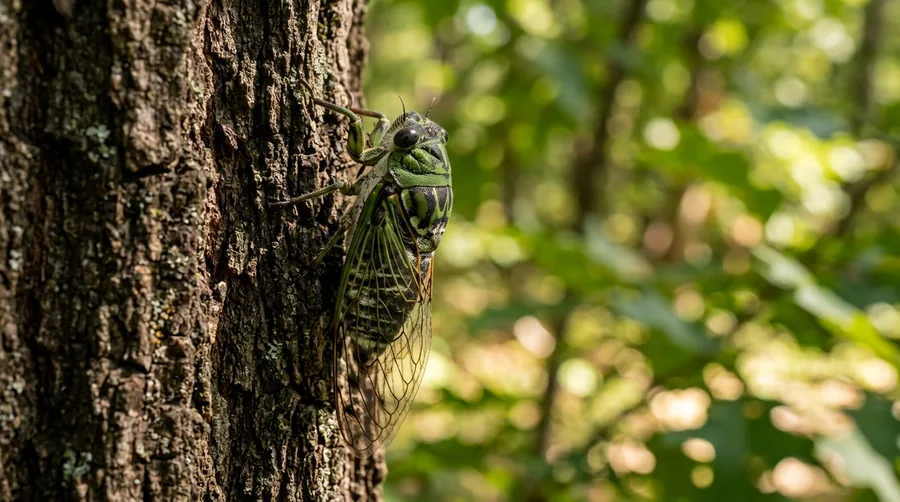
Green and black dog-day cicada with clear wings resting on a leaf in late summer
Recommended Products


What it does
Annual cicadas emerge in mid to late summer, the dog days, and are known for the loud whining buzz males make to attract mates during the hottest hours. They are strong but noisy fliers that cling to tree trunks and branches. Unlike periodical cicadas, they appear in modest numbers every year rather than in sudden mass broods.
Where it lives
Nymphs live in the soil feeding on tree-root sap, favoring yards, parks, and woodland edges with established trees. Adults rest and sing high in deciduous trees. Dog-day cicadas are found across the continental US wherever suitable trees grow, in both urban and rural settings.
How it breeds
Nymphs develop underground for two to five years, but because generations overlap, some adults emerge every summer. Adults live a few weeks: they mate, and females lay eggs in slits cut into twigs. Eggs hatch in weeks, and the nymphs drop and burrow into the soil to feed on roots until their own emergence.
What it eats
Cicadas feed only on plant fluids. Nymphs suck sap from tree roots underground for years; adults take small amounts of sap from twigs and branches. They do not chew foliage or feed on anything in the home.
Identification
Adults are large, 1.25 to 2 inches, with a stout green, brown, and black body, greenish wing veins, and clear wings held roof-like over the back. They are bigger and greener than the black, red-eyed periodical cicadas. Look for brown, split nymphal shells clinging to tree bark and fences.
Signs of an infestation
- Loud whining or buzzing from trees on hot afternoons
- Brown, split nymphal shells on trunks and fences
- Occasional large green cicadas on siding or screens
- Round emergence holes in soil beneath trees
- Cicadas caught in spider webs or taken by birds
Prevention tips
- No control is needed; enjoy them as a natural part of summer
- Net young or newly planted trees if twig damage is a concern
- Skip insecticides, which are unnecessary for their low numbers
- Leave established trees alone, as they tolerate the feeding
- Simply wait; adults disappear by early fall
Professional solutions
Annual cicadas essentially never require professional treatment. Their numbers are low, their season is short, and mature trees are unharmed. If a newly planted tree shows twig flagging from egg-laying, an arborist may suggest light pruning or netting, but chemical control is neither needed nor recommended.
Health & safety
Dog-day cicadas are harmless to humans and pets. They do not bite, sting, or transmit disease, and they are not venomous. Pets may catch and eat them without harm, though eating large quantities can cause a temporary upset stomach. Their loud song is a nuisance at most, not a danger.
Relevant Products




Frequently asked questions
What is the difference between annual and periodical cicadas?
Annual (dog-day) cicadas are large, green and black, and appear every summer in modest numbers. Periodical cicadas are smaller, black with red eyes, and emerge in enormous synchronized broods only every 13 or 17 years. Both are harmless; annual cicadas are the ones you hear most summers.
Do annual cicadas bite or sting?
No. Annual cicadas have no biting or stinging ability and carry no disease. They feed only on plant sap and are completely harmless to people and pets. The worst they do is startle you by flying into a screen or sing loudly on a hot afternoon.
Are cicadas harmful to my garden?
Not meaningfully. Cicadas feed on tree-root and twig sap, not garden vegetables or flowers. The only minor damage is flagging, where egg-laying browns the tips of thin twigs on young trees. Established trees and gardens are unaffected, so no treatment is warranted.
Fact-checked by Morgan Vance, Editorial Director (editorial review, not a professional pest-control or medical sign-off). Last reviewed July 5, 2026. We correct anything a reader shows us is wrong — see our corrections policy.