


Wild versus indoor lifespans
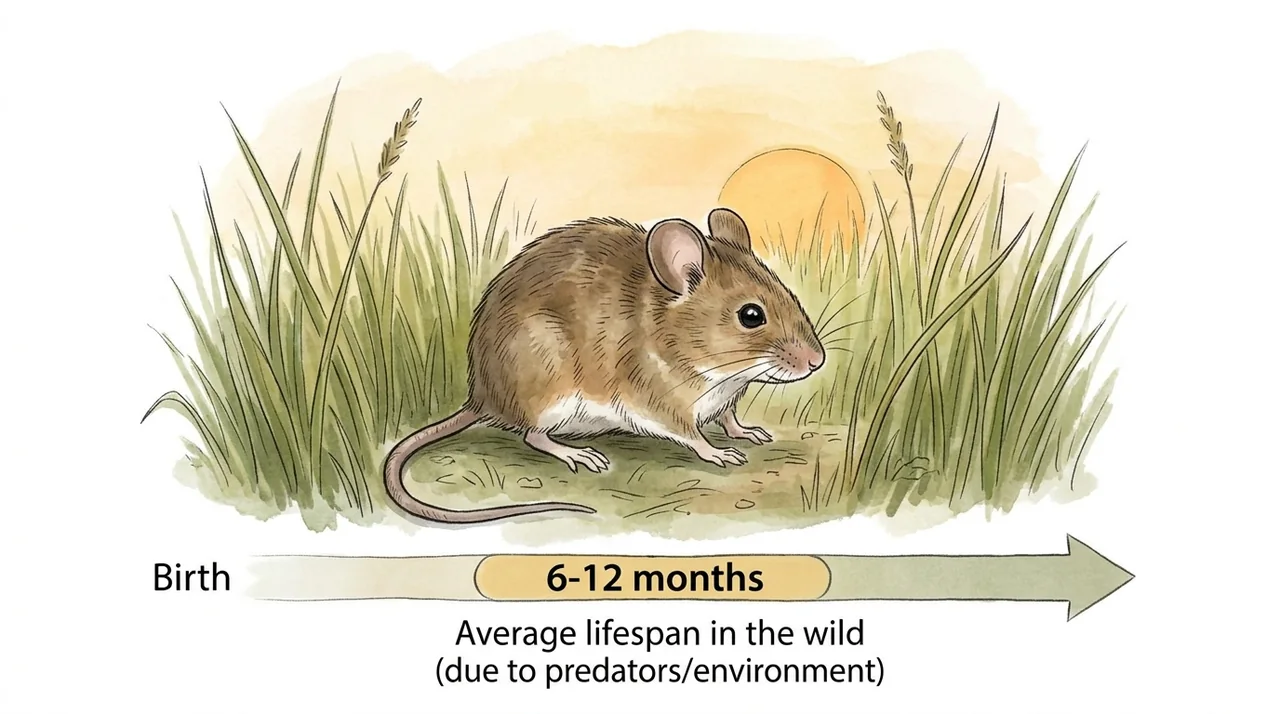
A mouse's lifespan depends heavily on where it lives. Outdoors, life is short and risky for the house mouse (Mus musculus). Predators, cold, disease, and food shortages take a heavy toll. Many wild mice survive only a few months, and most live less than a year.
Inside a house, conditions are far kinder. Steady warmth, hidden nesting spots, and reliable food and water let indoor mice live longer, commonly a year or more. Pet mice are fully protected from predators and given consistent care. They often reach one to two years. You can read more about the species on our house mouse library page.
What affects how long a mouse lives?
Several factors push a mouse's life toward the short or long end of that range:
- Predators: cats, owls, hawks, snakes, and foxes take a heavy toll outdoors.
- Weather: exposure to cold and wet is a major killer of wild mice.
- Food and water: scarcity outdoors versus abundance indoors makes a large difference.
- Shelter: a warm wall void or burrow is safer than an open field.
- Disease and competition: crowding and illness shorten lives in dense populations.
Why does lifespan matter for control?
What makes mice a challenge is not how long each one lives. It is how quickly they reproduce. A single female can produce several litters a year, each with several pups. The young reach breeding age in only a few weeks. So even a short-lived population can grow rapidly indoors. Removing a few visible mice rarely solves the problem on its own.
How do I keep the population down?
Breeding, not longevity, drives an infestation. So control focuses on food, shelter, and access:
- Seal entry points, since mice can squeeze through gaps around a quarter-inch wide.
- Store food and pet food in sealed containers.
- Reduce clutter that offers nesting sites.
- Set traps along walls where mice run and droppings appear.
Can I just wait a mouse problem out?
No. Because mice are so short-lived, it is tempting to assume the problem will fade on its own. The opposite usually happens. Long before the mice you first noticed reach old age, they can raise several litters. Those young mature and breed within weeks. Waiting simply gives the population time to grow and spread. Acting early with exclusion and trapping is far more effective than hoping the mice will die off.
Do mice die off in winter?
Not indoors. Cold weather kills many mice outside. But it is also the main reason they move into heated buildings in fall and winter. Once inside, they can stay active and keep breeding year-round. A warm home can actually extend both the lifespan and the breeding season of the mice living in it.