

How do mice climb so well?
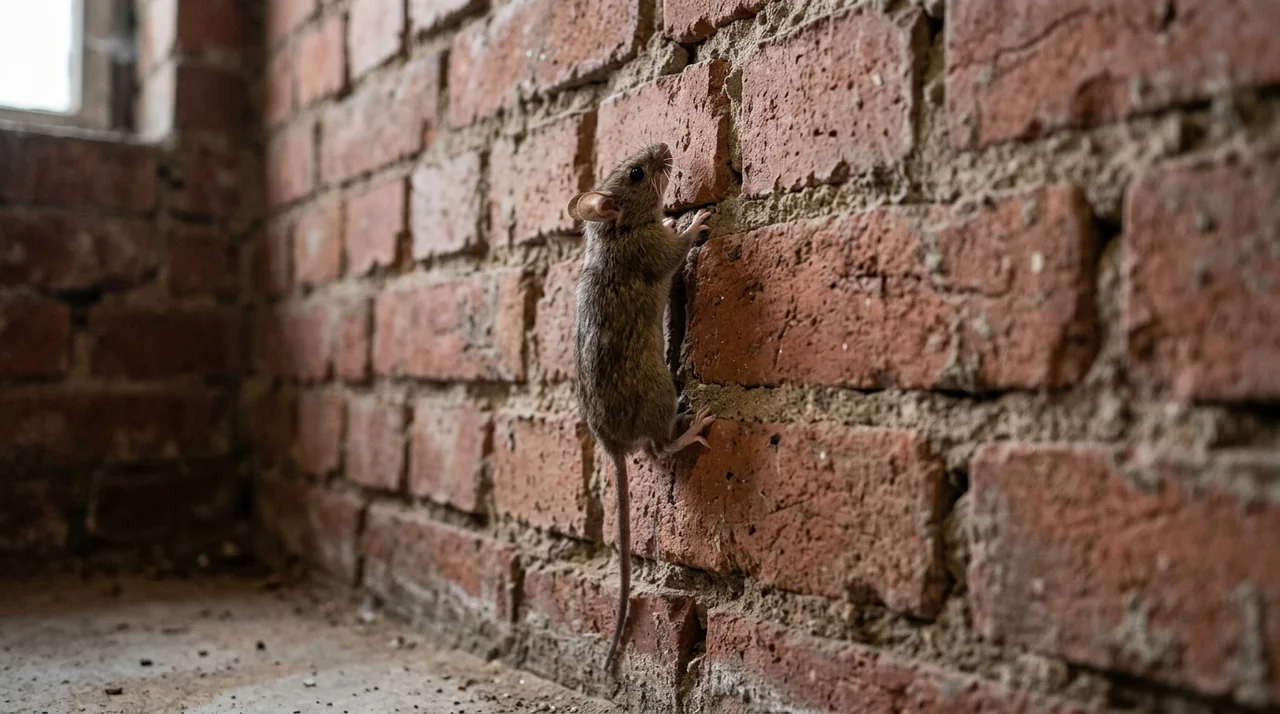
Mice are surprisingly athletic for their size. The house mouse (Mus musculus) has tiny, sharp claws that catch on the texture of common building materials. To a mouse, a rough wall is essentially a ladder. Mice use their tails for balance. They can climb brick, wood siding, stucco, cables, and even the inside of wall voids. Learn more about the species on our house mouse library page.
This climbing ability is why mice are not limited to ground level. They can reach counters, upper cabinets, attics, and rooflines by traveling up walls, pipes, and wiring.
What surfaces can and can't mice climb?
The deciding factor is texture. Rough, matte, or porous surfaces give a mouse's claws something to grip:
- Easy to climb: brick, concrete block, wood, stucco, drywall, rope, cables, and mesh.
- Hard to climb: smooth glass, glazed tile, and polished or slick metal, where the claws cannot find purchase.
How high can mice jump and climb, and can they survive falls?
Mice are capable jumpers. They can leap roughly a foot straight up from a flat surface, which lets them reach low counters and shelves. They are also agile enough to run along thin wires and pipe runs. They can even survive falls from heights that would seem dangerous for such a small animal. Combined with climbing, this vertical mobility means a mouse can travel through a building in three dimensions, not just along the floor.
Can mice climb stairs, furniture, and countertops?
Easily. Stairs are no obstacle at all. A mouse can scramble up the fabric or rough sides of furniture, then jump the short distance onto counters and open shelves. This is why storing food in sealed containers matters even for items kept up high. Height alone does not put food out of a mouse's reach.
Can mice climb inside walls and up pipes?
Yes, and this is often how they move between floors unseen. Wall voids, plumbing chases, and utility runs act like vertical highways. A mouse can enter near the foundation and climb inside the wall to reach an attic or an upper story. That is why scratching sounds sometimes come from ceilings and second-floor walls. Smooth vertical pipes are harder for them. But a rough bracket, nearby wire, or textured wall beside the pipe often gives them the grip they need.
What does this mean for keeping them out?
Because mice move vertically as well as horizontally, exclusion has to cover more than the floor:
- Inspect and seal gaps around rooflines, vents, and upper-story utility penetrations, not just the foundation.
- Cover chimney and attic vents with fine metal mesh.
- Trim tree branches and vines that give mice a route onto the roof.
- Use steel wool and sealant on any gap around a quarter-inch or larger, at every height.