
Vegetable Weevil
Listroderes difficilis · also called vegetable weevil
Quick answer
The vegetable weevil (Listroderes difficilis) is a grayish-brown, short-snouted beetle whose adults and green larvae feed at night on turnips, carrots, spinach, cabbage, and other cool-season vegetables. Active mainly in fall through spring in the southern US, it chews leaves and crowns. In the US, populations are all female and reproduce without mating.
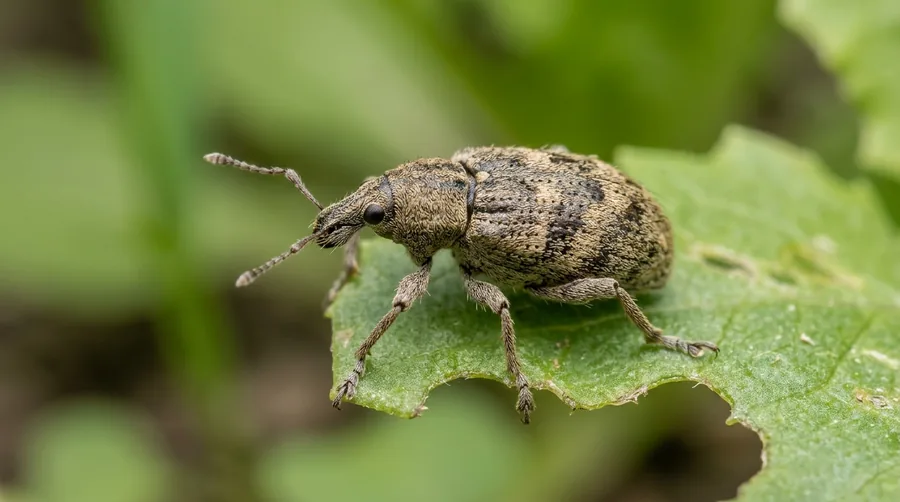
Grayish-brown vegetable weevil with a short snout and a pale V mark on its back on a leafy vegetable
Recommended Products


What it does
Both the adult beetles and the green larvae feed at night and hide by day in soil, mulch, or the plant crown. They chew leaves, buds, and growing points, sometimes destroying the crowns of root and leafy vegetables. Adults are flightless and drop and 'play dead' when disturbed, which helps them avoid notice.
Where it lives
The vegetable weevil is chiefly a cool-season pest of the southern and western US, including the Southeast, Gulf Coast, south-central states, and parts of California. It is most active from fall through spring on garden vegetables and weedy hosts, sheltering in soil and debris during the day and in summer heat.
How it breeds
In the US the vegetable weevil is parthenogenetic, meaning all individuals are female and lay fertile eggs without mating. Eggs are laid on or near host plants in cool months; larvae feed for several weeks, then pupate in the soil. There is generally a single generation per year, with adults surviving into a second season.
What it eats
It feeds on a range of cool-season vegetables, especially turnip, carrot, radish, spinach, beet, potato, cabbage, mustard, and lettuce, along with related weeds. Adults and larvae both chew foliage, buds, and crowns.
Identification
Adults are dull grayish-brown weevils about 6-8 mm with a short, broad snout and a faint pale V or chevron mark near the rear of the back. The larvae are pale green, legless, and about 10 mm, feeding openly at night. The short snout and pale V help separate it from other garden weevils.
Signs of an infestation
- Leaves and buds notched or chewed, mostly overnight
- Green legless larvae feeding on foliage after dark
- Damaged or destroyed crowns of root and leafy crops
- Dull gray-brown weevils that drop and play dead when disturbed
- Cool-season damage that stops in summer heat
Prevention tips
- Scout crops at night, when adults and larvae are active
- Handpick beetles and larvae into soapy water
- Clear weeds and debris that provide daytime shelter
- Rotate cool-season vegetables and remove crop residue
- Cultivate soil lightly to expose pupae and disrupt shelter
Professional solutions
Handpicking, sanitation, and row covers manage most home-garden infestations, since there is just one generation a year. Insecticidal options exist for heavy pressure; because larvae and adults feed at night, treat in the evening. Your Cooperative Extension office can confirm the weevil and recommend cool-season-appropriate control if damage persists.
Health & safety
The vegetable weevil is harmless to people and pets, with no bite, sting, or human-disease risk. Its impact is entirely on plants: nighttime feeding by adults and larvae can defoliate and destroy the crowns of cool-season vegetables, especially in seedlings and young transplants.
Relevant Products


Frequently asked questions
What is eating my fall vegetables at night?
Notching and chewing on cool-season vegetables like turnips, spinach, and cabbage that appears overnight often points to the vegetable weevil. Both the gray-brown adult beetles and pale green larvae feed after dark and hide by day, so scout with a flashlight to find them.
How do vegetable weevils reproduce without males?
In the US the vegetable weevil is parthenogenetic: all individuals are female and lay fertile eggs without mating. This lets even a few weevils establish a population, though there is typically only one generation per year, mostly active in the cool fall-to-spring season.
How do I control vegetable weevils in the garden?
Because they feed at night and there is one generation a year, evening handpicking, clearing weedy daytime shelter, rotating crops, and using row covers are effective. Treat with a labeled insecticide in the evening only if damage is heavy on seedlings or crowns.
Fact-checked by Morgan Vance, Editorial Director (editorial review, not a professional pest-control or medical sign-off). Last reviewed May 5, 2026. We correct anything a reader shows us is wrong — see our corrections policy.