
Tarnished Plant Bug
Lygus lineolaris · also called lygus bug, plant bug
Quick answer
The tarnished plant bug (Lygus lineolaris) is a small, mottled brown oval insect marked with a pale triangle on its back. One of the most damaging US plant bugs, it feeds on hundreds of crops and ornamentals, injecting saliva that distorts buds, fruit, and shoots. It does not harm people.
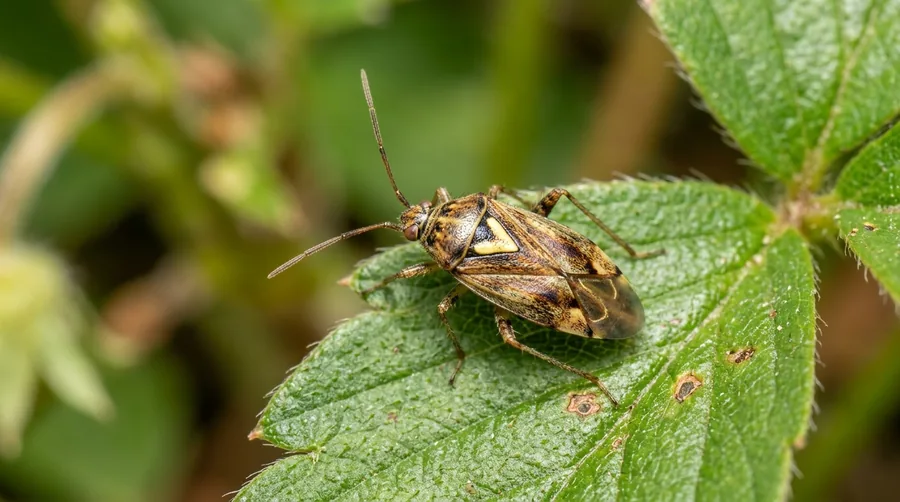
Small mottled brown tarnished plant bug with a pale triangle marking on a leaf
Recommended Products


What it does
Tarnished plant bugs are fast-moving, wary insects that fly readily and feed by piercing buds, shoots, flowers, and fruit, injecting saliva that kills tissue and distorts growth. Feeding causes deformed cat-faced fruit, dropped buds and flowers, and dead spots. They are among the most damaging and wide-ranging plant bugs in the US.
Where it lives
They live in gardens, orchards, nurseries, and field crops, and overwinter as adults under leaf litter, bark, and debris along field edges and hedgerows. In spring they move onto weeds and crops. They are found throughout the US wherever suitable host plants grow, from vegetable beds to cotton and alfalfa fields.
How it breeds
Overwintered adults become active early in spring and females insert eggs into plant tissue. Pale green nymphs hatch and feed on tender growth, maturing through several stages in a few weeks. There are commonly two to several generations per year, with numbers building over the season.
What it eats
Tarnished plant bugs are highly polyphagous, feeding on the buds, shoots, flowers, and fruit of hundreds of plants, including strawberries, vegetables, fruit trees, cotton, alfalfa, and many ornamentals and weeds.
Identification
Adults are about 5-6 mm, oval, and mottled in brown, tan, and yellow, with a small pale yellow triangle on the back near the wing tips. Nymphs are pale green and can be mistaken for aphids, but move much faster and lack aphids' tailpipe-like structures.
Signs of an infestation
- Deformed, dimpled, or cat-faced fruit and berries
- Blackened, dead buds and dropped flowers
- Distorted new growth and dead spots on shoots
- Small mottled brown bugs and fast green nymphs on tender growth
Prevention tips
- Control weeds in and around gardens that host the bugs
- Clear leaf litter and debris where adults overwinter
- Use row covers on vulnerable crops such as strawberries
- Scout tender growth early and treat nymphs before numbers climb
Professional solutions
These highly mobile bugs are hard to control because adults re-invade from surrounding weeds and fields. Weed management and early treatment of nymphs are the practical tools. For commercial or persistent problems, an extension or crop advisor can recommend well-timed, targeted options, since broad spraying is often ineffective against re-invading adults.
Health & safety
Tarnished plant bugs do not bite or sting people in any meaningful way, spread human disease, or damage structures, so they pose no health risk. Their damage is agricultural and horticultural, reducing the yield and quality of fruit, vegetables, and field crops.
Relevant Products


Frequently asked questions
What does tarnished plant bug damage look like?
Feeding kills and distorts plant tissue, producing dimpled or cat-faced fruit and berries, blackened buds, dropped flowers, and twisted new growth with dead spots. On strawberries and vegetables the deformed fruit is often the first clue, since the bugs themselves are small and quick to hide.
Are tarnished plant bugs dangerous to people?
No. They feed on plants and do not bite, sting, or transmit disease to humans or pets. The concern is entirely to gardens and crops, where their wide host range and mobility make them a significant agricultural pest.
Why are tarnished plant bugs so hard to control?
They are highly mobile, feed on hundreds of plants, and constantly re-invade from surrounding weeds and field edges, so even after treatment new adults arrive. Managing nearby weeds and treating young nymphs early is more effective than trying to spray fast-moving adults.
Fact-checked by Morgan Vance, Editorial Director (editorial review, not a professional pest-control or medical sign-off). Last reviewed July 7, 2026. We correct anything a reader shows us is wrong — see our corrections policy.