Straw Itch Mite
Pyemotes tritici · also called straw itch mites, grain itch mite, hay itch mite
Quick answer
The straw itch mite (Pyemotes tritici) is a nearly invisible mite that normally preys on grain and stored-product insect larvae. When people handle infested hay, straw, seeds, or grain, the mites bite, causing intensely itchy welts. The rash is uncomfortable but the mites cannot live on humans or infest a home.
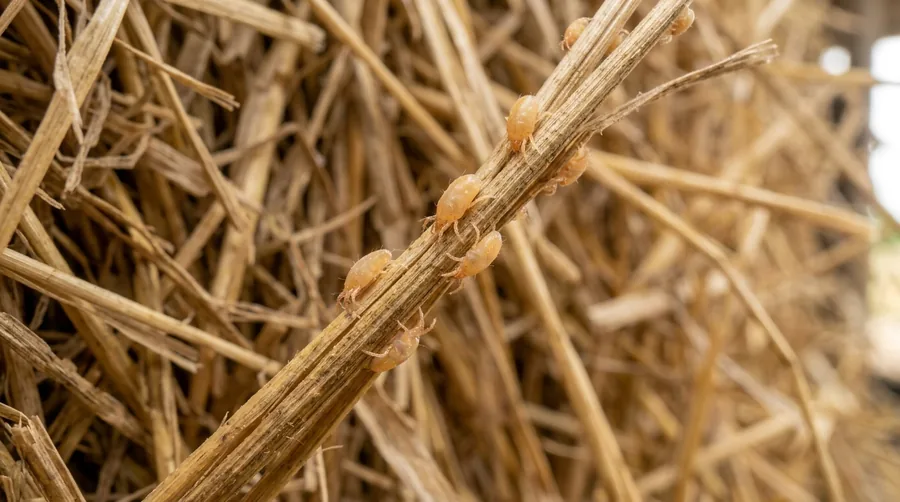
Highly magnified pale straw itch mite; itchy welts shown on a person's forearm
Recommended Products


What it does
Straw itch mites are parasites of the larvae of grain and wood-boring insects. Females paralyze host larvae, feed, and give birth to fully developed offspring. When their insect hosts are abundant in stored straw, hay, grain, or seeds, mite numbers surge, and people who contact the material get bitten as incidental targets.
Where it lives
They live in stored and field hay, straw, grain, dried beans, seeds, and grasses, wherever their stored-product insect hosts occur. They are found nationwide, most notably in agricultural areas, barns, and homes that bring in infested straw, mattresses, or grain. They do not colonize the home itself.
How it breeds
Reproduction is exceptionally fast. Females carry developing young internally and give birth to mature adults, so a population can multiply enormously in a short time when host larvae are plentiful. Numbers crash once the host insects or the infested material are removed, and the mites cannot sustain themselves on people.
What it eats
The mites feed on the body fluids of insect larvae infesting grain, straw, seeds, and wood. They do not feed on human blood; bites on people are defensive or incidental and do not nourish them.
Identification
Individual mites are about 0.2 mm and effectively invisible to the naked eye, so the bites are usually noticed before the mite. Diagnosis is based on the itchy rash plus a history of contact with hay, straw, grain, or seeds. Microscopy is needed to see the pale, elongated, engorged females.
Signs of an infestation
- Sudden intensely itchy welts after handling straw, hay, or grain
- Rash on the arms, neck, and trunk where material contacted skin
- Small red bumps sometimes topped with a tiny blister
- Multiple people or animals itching after the same exposure
- No visible mite despite obvious bites
Prevention tips
- Wear long sleeves and gloves when handling hay, straw, or grain
- Store grain and seed in sealed containers to limit host insects
- Remove or discard infested straw, hay, and seed sources
- Launder and shower promptly after working with stored plant material
- Control stored-product insects that the mites feed on
Professional solutions
Straw itch mite outbreaks are usually solved by removing the infested material rather than by treating a structure. If stored-product insects are the underlying source, a pest professional can treat and manage that infestation, which removes the mites' food supply. Insecticidal treatment of people is not appropriate; medical care manages the rash.
Health & safety
Bites cause intensely itchy red welts, sometimes with tiny blisters, and heavy exposure can occasionally bring on headache, nausea, or fever that warrants seeing a doctor. The mites do not burrow, live on, or infest people, and they spread no disease. Antihistamines and soothing lotions ease symptoms; secondary infection from scratching is the main complication.
Relevant Products


Frequently asked questions
Why do I have itchy welts but can't find any bug?
Straw itch mites are about 0.2 mm and essentially invisible, so bites appear with no visible culprit. The giveaway is a history of handling hay, straw, grain, or seeds. The mites cannot live on you; removing the infested material stops new bites.
Can straw itch mites infest my house or live on me?
No. They cannot survive on humans or colonize a home. They depend on the insect larvae inside stored straw, hay, and grain. Once that material or its stored-product pests are removed, the mites die off. Bites are treated as a temporary skin irritation.
Fact-checked by Morgan Vance, Editorial Director (editorial review, not a professional pest-control or medical sign-off). Last reviewed June 18, 2026. We correct anything a reader shows us is wrong — see our corrections policy.