Bird Mite
Dermanyssus gallinae / Ornithonyssus spp. · also called bird mites, chicken mite, red mite
Quick answer
Bird mites (Dermanyssus gallinae and Ornithonyssus species) are nearly microscopic parasites of birds. When nestlings leave or a nest is removed, hungry mites move indoors and bite people, causing itching and irritation. They cannot survive or reproduce on human blood, so eliminating bird nests is the key to control.
Extremely small pale bird mite on white skin near a feather
Recommended Products
See the full ranking →


What it does
Bird mites are tiny parasites that feed on the blood of birds in and around the nest. When a nest is abandoned, the young fledge, or a nest is removed, the mites lose their host and disperse in large numbers, sometimes moving indoors along walls, vents, and light fixtures and biting people they encounter. They are most active in warm months.
Where it lives
Bird mites live in bird nests and roosts, including those built in eaves, attics, vents, chimneys, and window ledges by pigeons, sparrows, starlings, and poultry. Indoor invasions occur where a nest is close to living space. Without birds they cannot sustain themselves, and they occur nationwide wherever nesting birds are near buildings.
How it breeds
Females lay eggs in the nest after a blood meal. Eggs hatch into larvae, then nymphs, and mature to adults, a cycle that can finish in about a week under warm conditions, letting populations build very rapidly during nesting season. On human blood, however, mites cannot complete their life cycle and eventually die off.
What it eats
Bird mites feed on the blood of birds and, when their host is gone, will bite people and other mammals, though they cannot reproduce on that blood. Some species also scavenge on organic debris in the nest. They cannot survive long without a bird host.
Identification
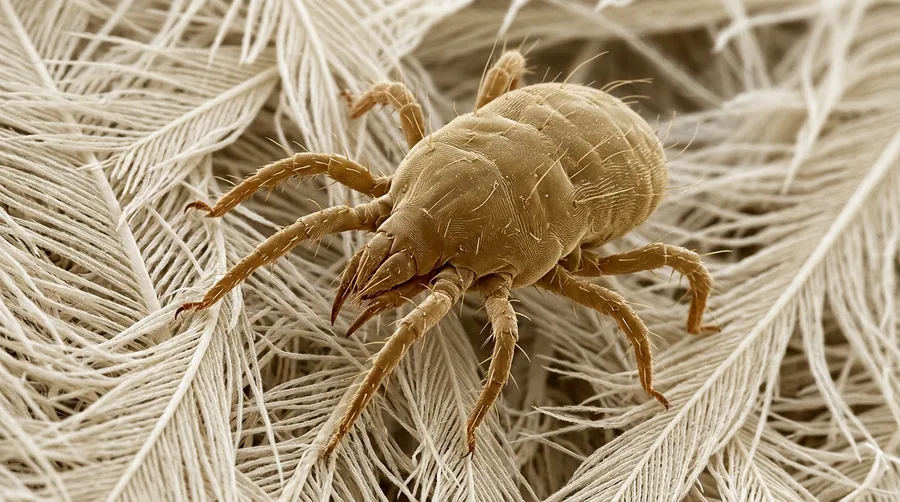
Bird mites are minute, 0.5-1 mm, roughly pinhead-sized or smaller, and appear whitish or gray, turning red or dark after feeding on blood. With eight legs, they are arachnids, not insects. They are usually noticed as tiny moving specks near nesting areas or as unexplained itchy bites rather than by clear features.
Signs of an infestation
- Itchy bites or crawling sensations near windows or vents
- Tiny moving specks on sills, walls, or light fixtures
- Bites starting after a bird nest was disturbed or removed
- Mite activity concentrated near attics, eaves, or chimneys
- A sudden indoor mite problem in spring or summer
Prevention tips
- Discourage birds from nesting on eaves, ledges, and vents
- Screen or cap vents, chimneys, and gaps birds use
- Remove abandoned nests only after birds have gone, using protection
- Clean and treat the nest site area after nest removal
- Seal entry points between nest sites and living space
Professional solutions
Control centers on removing the bird nest source and sealing entry points, after which stray mites die off within weeks since they cannot breed on people. Vacuuming and cleaning affected areas helps. For nests in hard-to-reach voids or large infestations, a pest or wildlife professional can remove nests safely and treat harborage areas.
Health & safety
Bird mite bites cause itching, redness, and irritation, and some people react more strongly, but the mites are not known to transmit disease to humans and cannot live or reproduce on human blood. The problem is self-limiting once the bird source is removed. Treat bites with anti-itch care and watch for infection from scratching.
Relevant Products




Frequently asked questions
Why did I suddenly start getting bitten by tiny mites?
A common cause is a bird nest nearby, in an eave, vent, attic, or chimney, whose young have left or that was removed. The mites lose their bird host and disperse indoors, biting people. Removing the nest source and sealing entry points is the key to stopping them.
Can bird mites live on humans?
No. Bird mites will bite people, causing itching and irritation, but they cannot survive or reproduce on human blood. Once their bird host and nest are gone, the stray mites die off within a few weeks, so eliminating the nest source resolves the problem.
Do bird mites spread disease?
Bird mites are not known to transmit disease to humans. The concern is the itchy bites and irritation they cause and the risk of infection from scratching. Because they are self-limiting once the nest is removed, control focuses on the bird source rather than repeated spraying of living space.
Fact-checked by Morgan Vance, Editorial Director (editorial review, not a professional pest-control or medical sign-off). Last reviewed May 28, 2026. We correct anything a reader shows us is wrong — see our corrections policy.