
Squash Beetle
Epilachna borealis · also called squash beetles, squash lady beetle
Quick answer
The squash beetle (Epilachna borealis) is a plant-eating ladybug relative, orange-yellow with large black spots, that skeletonizes the leaves of squash, pumpkin, and other cucurbits. Unlike helpful ladybugs, both its spiny yellow larvae and spotted adults feed on foliage. It is common in eastern US gardens and is often mistaken for a beneficial beetle.
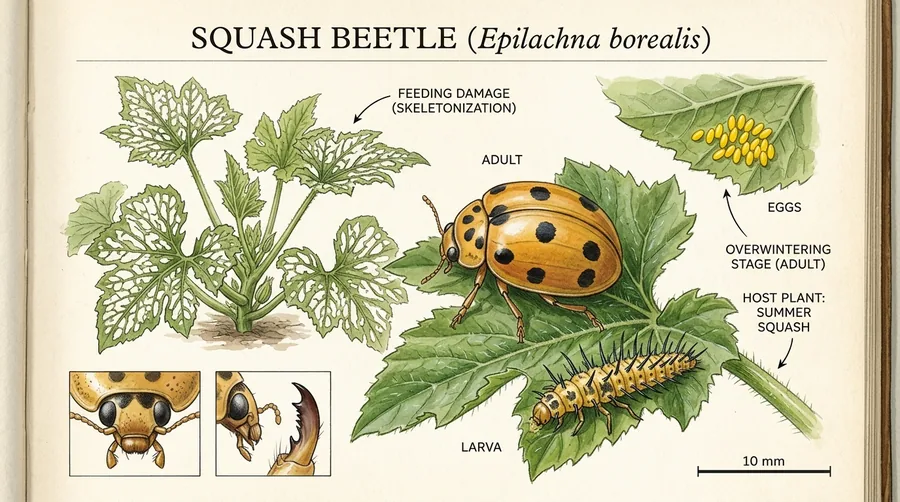
Orange-yellow squash beetle with large black spots resembling a big ladybug on a squash leaf
Recommended Products


What it does
Adults and larvae feed mostly on the underside of cucurbit leaves, scraping away tissue and leaving a lacy, skeletonized surface that later browns and dies. Feeding often follows a distinctive circular-trenching pattern. Heavy activity can defoliate vines, reducing yield, and the beetle is easily confused with a beneficial ladybug.
Where it lives
The squash beetle occurs across the eastern and central US in home gardens and small farms wherever cucurbits are grown. Adults overwinter in sheltered debris and field edges, then move onto squash, pumpkin, and cantaloupe as plantings develop through the summer.
How it breeds
Females lay clusters of yellow eggs on the underside of leaves. The larvae are yellow and covered in branched, dark-tipped spines; they feed for a few weeks, then pupate on the plant. Most areas see one to two generations per year, with adults present through the warm months.
What it eats
Both larvae and adults feed on cucurbits: squash, pumpkin, gourds, cantaloupe, and cucumber leaves, and occasionally the rind of fruit. It does not feed on aphids or other insects the way predatory ladybugs do.
Identification
Adults are 7-10 mm, noticeably larger than a common ladybug, orange-yellow with about seven black spots on each wing cover. The yellow, oval larvae bear rows of branching spines. The large size, dull yellow-orange color, and spiny larvae separate it from helpful spotted ladybugs.
Signs of an infestation
- Lacy, skeletonized patches on the underside of cucurbit leaves
- Circular or trench-shaped feeding scars on leaves
- Large orange-yellow spotted beetles on squash and pumpkin
- Spiny yellow larvae clustered on leaf undersides
- Browning, collapsing foliage on heavily fed vines
Prevention tips
- Handpick adults, larvae, and egg clusters into soapy water
- Check leaf undersides regularly through the growing season
- Use row cover on young plants, opening it for pollination
- Remove and compost spent cucurbit vines after harvest
- Learn to tell it from beneficial ladybugs before treating
Professional solutions
Handpicking and row covers control the squash beetle in nearly all home gardens; insecticidal soap or labeled products help with heavy larval outbreaks. Because it is easily confused with beneficial ladybugs, confirm the identification first. Your Cooperative Extension office can verify the beetle and suggest cucurbit-safe treatment if damage is severe.
Health & safety
The squash beetle is harmless to humans and pets, with no bite, sting, or disease risk. Its only impact is on plants, where sustained leaf feeding can weaken cucurbit vines and cut yield. The main practical caution is not to mistake it for, or kill, the beneficial ladybugs it resembles.
Relevant Products


Frequently asked questions
Is the squash beetle a ladybug?
It is a relative of ladybugs but a plant feeder, not a helpful predator. The squash beetle is larger than a common ladybug, orange-yellow with about seven black spots per wing, and both it and its spiny yellow larvae skeletonize cucurbit leaves rather than eating aphids.
What is skeletonizing my squash leaves?
Lacy, skeletonized patches on the underside of squash or pumpkin leaves usually mean squash beetles. Check the leaf undersides for large orange-yellow spotted beetles and yellow, spiny larvae, and remove them by hand into soapy water.
How do I get rid of squash beetles safely?
Handpicking adults, larvae, and egg clusters is the simplest and safest approach, along with row covers on young plants. Insecticidal soap helps with heavy larval activity. Confirm the identification first so you do not harm the beneficial ladybugs the squash beetle resembles.
Fact-checked by Morgan Vance, Editorial Director (editorial review, not a professional pest-control or medical sign-off). Last reviewed June 29, 2026. We correct anything a reader shows us is wrong — see our corrections policy.