
Pickleworm
Diaphania nitidalis · also called pickleworms, melonworm relative
Quick answer
The pickleworm (Diaphania nitidalis) is the caterpillar of a night-flying moth that bores into the blossoms and fruit of cucumbers, squash, cantaloupe, and other cucurbits. Its tunneling ruins fruit and lets in rot. It overwinters only in the far South and Gulf Coast, spreading northward each summer.
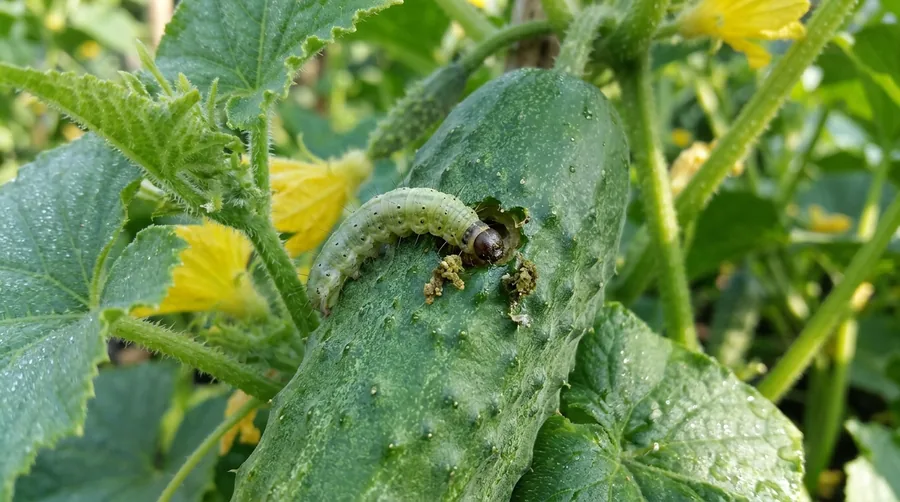
Pale green pickleworm caterpillar boring into a yellow summer squash fruit
Recommended Products


What it does
Young larvae feed first in the blossoms, then bore into stems and especially fruit, leaving small holes surrounded by wet, sawdust-like frass. Because they tunnel inside the fruit, the damage is often hidden until a squash or melon is cut open. The moths are active at night and hide by day.
Where it lives
Pickleworms are a Southern and Gulf Coast problem, unable to survive cold winters except in south Florida and southern Texas. From there, moths spread north through the summer, reaching the mid-Atlantic and lower Midwest by late season on warm, cucurbit-growing sites.
How it breeds
Females lay tiny eggs in small clusters on buds, flowers, and new growth. Larvae feed and tunnel for about two weeks through several instars, then pupate in a rolled leaf. Generations follow quickly in warm weather, so several overlapping generations build up as the season progresses.
What it eats
Larvae feed on cucurbits: summer and winter squash, cucumbers, cantaloupe, and pumpkins, favoring blossoms and fruit. Summer squash is especially attractive. Adults feed on nectar and do not damage plants.
Identification
Mature larvae reach about 20 mm and are pale green to coppery; younger larvae have numerous dark spots that fade as they grow. The adult is an attractive moth about 25 mm across with pale, semi-transparent wing centers bordered in dark brown and a distinctive brush-like tuft at the tip of the abdomen.
Signs of an infestation
- Small entry holes in squash, cucumber, or melon fruit
- Wet, sawdust-like frass around holes in fruit and stems
- Rotting or collapsing fruit from internal tunneling
- Chewed, discolored blossoms
- Green caterpillars found inside cut-open fruit
Prevention tips
- Plant early so fruit sets before migrating moths arrive
- Cover plants with row cover, removing it only for pollination
- Choose less-preferred varieties where pickleworm pressure is high
- Remove and destroy infested fruit and crop residue promptly
- Scout blossoms and young fruit, since larvae are easiest to reach early
Professional solutions
Row covers and early planting are the mainstays for gardeners; Bacillus thuringiensis (Bt) can help when directed at young larvae before they bore in. Once caterpillars are inside fruit, sprays cannot reach them. For persistent losses, your Cooperative Extension office can advise on timing and cucurbit-safe products.
Health & safety
The pickleworm is not a health threat. It does not bite, sting, or carry human disease, and finding one in a fruit is unpleasant but not dangerous. Its impact is purely to the harvest, since internal tunneling ruins fruit and opens the way for secondary rot.
Relevant Products


Frequently asked questions
What is the green worm inside my squash?
A pale green or coppery caterpillar tunneling inside squash, cucumber, or melon fruit is almost certainly a pickleworm. Look for small entry holes surrounded by wet, sawdust-like frass. The caterpillar feeds hidden inside the fruit, so damage is often found only when you cut it open.
How do I stop pickleworms without spraying?
Plant cucurbits early so fruit sets before migrating moths arrive, cover plants with floating row cover (opening it for pollination), and remove infested fruit quickly. Bt targeted at young larvae in the blossoms helps before they bore into fruit.
Where are pickleworms a problem?
Pickleworms survive winter only in the far South, mainly south Florida and southern Texas, then spread northward each summer. Southeastern and Gulf Coast gardens see the heaviest and earliest pressure, while northern areas are usually affected only late in the season.
Fact-checked by Morgan Vance, Editorial Director (editorial review, not a professional pest-control or medical sign-off). Last reviewed July 27, 2026. We correct anything a reader shows us is wrong — see our corrections policy.