
Spruce Spider Mite
Oligonychus ununguis · also called spruce spider mite, conifer spider mite
Quick answer
The spruce spider mite (Oligonychus ununguis) is one of the most damaging pests of conifers, attacking spruce, juniper, arborvitae, hemlock, and pine. A cool-season mite, it feeds in spring and fall, stippling and bronzing needles and killing inner foliage. Tiny and easy to overlook, it harms evergreens but poses no risk to people or pets.
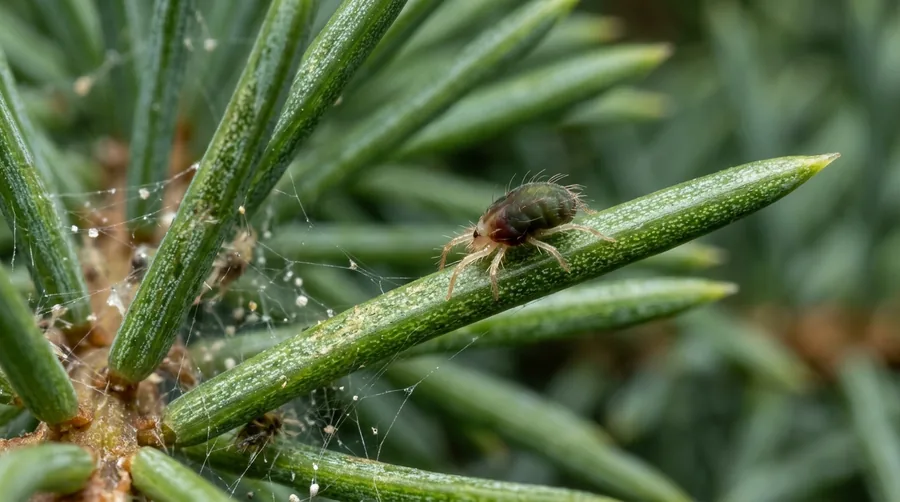
Bronzed, stippled spruce needles with fine webbing and specks of spruce spider mites
Recommended Products


What it does
Spruce spider mites feed on needles by piercing cells and draining their contents, producing tiny yellow speckles that merge into a bronzed, rusty look. Older, inner needles are hit first and may brown and drop, thinning the plant from the inside out. Fine webbing appears in heavy infestations. Populations surge in cool spring and fall weather.
Where it lives
It attacks many conifers, especially dwarf Alberta and other spruces, plus juniper, arborvitae, hemlock, pine, and fir, in landscapes, hedges, and nurseries. Widespread across the northern US, it feeds on the needles, often building up first on stressed or dusty plants in sheltered spots.
How it breeds
This cool-season mite completes a generation in one to two weeks during spring and fall, producing many overlapping generations. Females lay overwintering eggs at the base of needles and on bark; these hatch in spring. Activity slows in midsummer heat and picks up again as temperatures cool in fall.
What it eats
Spruce spider mites feed solely on the sap and cell contents of conifer needles. They do not feed on any household materials and cannot survive off their evergreen hosts.
Identification
The mites are minute (about 0.4 mm) and dark green to reddish-brown; tapping a branch over white paper reveals moving specks that smear when crushed. The visible symptoms, stippled, bronzed, rusty needles, inner-needle browning, and fine webbing on conifers in spring or fall, are the practical way to identify it.
Signs of an infestation
- Yellow stippling that turns needles bronze or rusty
- Browning and drop of older, inner needles
- Fine silk webbing among needles and twigs
- Tiny specks that move and smear on white paper
- A thinning, off-color evergreen, worst in spring and fall
Prevention tips
- Hose down foliage periodically to dislodge mites and dust
- Inspect conifers in spring and fall using the white-paper tap test
- Keep evergreens well watered to avoid drought stress
- Preserve predatory mites and other natural enemies
- Avoid unnecessary broad-spectrum insecticides that spare mites
Professional solutions
Detected early, spruce spider mites respond to hosing and horticultural oil timed to the cool seasons. For heavy or repeated damage on valuable evergreens, professionals apply labeled miticides and rotate chemistries, since these mites reproduce fast and can rebound. Timing treatments to spring and fall activity is essential.
Health & safety
The spruce spider mite does not bite, sting, or spread disease to humans or animals and never enters homes. It is purely a plant pest, so its damage is limited to the health and appearance of conifers, with no risk to people or pets.
Relevant Products


Frequently asked questions
Why are my spruce or arborvitae needles turning bronze?
Bronzed, rusty, stippled needles with fine webbing, especially on inner and older foliage, are typical spruce spider mite damage. Tap a branch over white paper; tiny specks that crawl and smear confirm the mites. Damage usually peaks in spring and fall.
How do I check for spruce spider mites?
Hold a sheet of white paper under a branch and tap it sharply. If tiny specks fall and slowly move, and smear when you wipe them, spruce spider mites are present. Check in spring and fall, when this cool-season mite is most active.
Are spruce spider mites harmful to people?
No. They do not bite, sting, or carry disease, and they cannot live indoors or on people. They feed only on conifer needles. The concern is preventing the browning, needle drop, and thinning they cause on evergreens.
Fact-checked by Morgan Vance, Editorial Director (editorial review, not a professional pest-control or medical sign-off). Last reviewed May 11, 2026. We correct anything a reader shows us is wrong — see our corrections policy.