
Cyclamen Mite
Phytonemus pallidus · also called cyclamen mite, strawberry mite
Quick answer
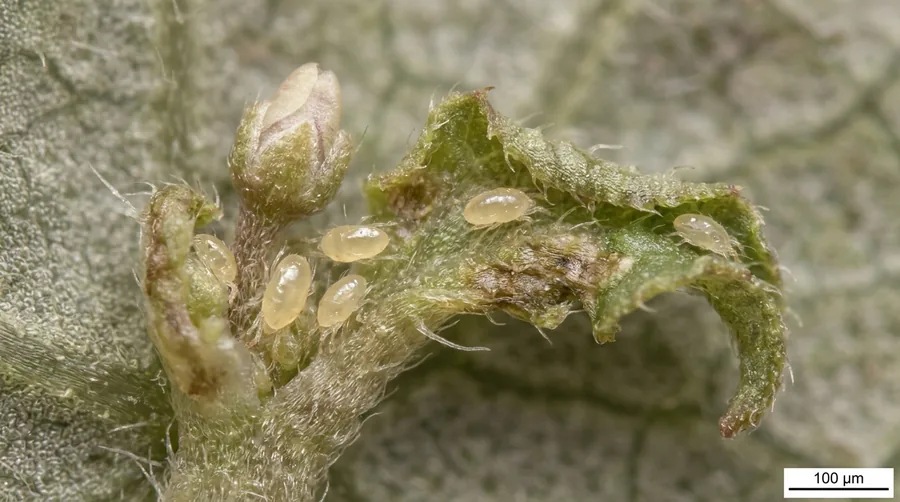
The cyclamen mite (Phytonemus pallidus) is a microscopic mite that infests strawberries, cyclamen, African violets, and many greenhouse and houseplants. Hiding in buds and new growth, it causes twisted, stunted, discolored leaves and deformed flowers. Far too small to see without magnification, it harms plants only and never bites people.
Distorted, curled new leaves and stunted flower buds on an African violet damaged by cyclamen mites
Recommended Products



What it does
Cyclamen mites hide in the protected buds, folded new leaves, and flower crowns of their hosts, feeding on the tender tissue. Their feeding and saliva distort growth, so leaves emerge curled, thickened, brittle, and discolored, and flower buds fail or open deformed. They avoid light and stay hidden, making them easy to miss.
Where it lives
They thrive in warm, humid, shaded conditions: greenhouses, indoor plant collections, and shaded garden beds. Common hosts include strawberry, cyclamen, African violet, gerbera, gloxinia, ivy, and snapdragon. They spread on infested plants, on hands, and on tools, and occur wherever these plants are grown.
How it breeds
In warm, humid conditions a generation takes only one to a few weeks, so populations build quickly year-round indoors. Females lay eggs in the hidden crevices of new growth; the young pass through immature stages before maturing. Warmth and high humidity greatly speed reproduction.
What it eats
Cyclamen mites feed only on plant tissue, piercing the cells of buds, young leaves, and flowers to draw sap. They do not feed on people, animals, or anything in the home besides their host plants.
Identification
The mites are microscopic (about 0.2 mm) and cannot be seen without magnification, so identification relies on symptoms: severely stunted, twisted, and thickened new leaves, a puckered plant center, and deformed or aborted flowers. Damage often clusters in the newest growth while older leaves look normal.
Signs of an infestation
- Twisted, stunted, brittle new leaves
- Puckered or deformed plant center and growing tips
- Flower buds that fail to open or open distorted
- Darkened, streaked, or discolored young foliage
- Overall dwarfing while older leaves stay normal
Prevention tips
- Inspect and isolate new plants before adding them to a collection
- Discard heavily infested plants to protect the rest
- Avoid moving mites on hands and tools between plants
- Keep humidity moderate rather than constantly high and warm
- Wash hands and sanitize tools after handling suspect plants
Professional solutions
Because the mites hide in buds and are microscopic, control is difficult and reinfestation is common. Removing badly infested plants is often the simplest fix. For valuable collections, professionals may use labeled miticides or, in some crops, hot-water treatment, and introduce predatory mites in greenhouses.
Health & safety
Cyclamen mites are strictly plant pests. They do not bite, sting, or transmit disease to humans or pets, and they cannot live on people. The only impact is stunted, deformed plants, so there is no risk to human health.
Relevant Products


Frequently asked questions
Why is the new growth on my African violet twisted and stunted?
Twisted, thickened, stunted new leaves and a puckered center on African violets or cyclamen usually mean cyclamen mites. They are microscopic and hide in the buds, so you see the damage, not the mites. Deformed flowers that fail to open are another common sign.
Can I see cyclamen mites?
Not with the naked eye. At about 0.2 mm they are microscopic, so diagnosis is based on the distorted, stunted new growth and deformed flowers they cause. Older leaves often look normal while the newest growth is severely puckered and discolored.
How do I get rid of cyclamen mites?
They are stubborn because they hide in buds and reproduce fast. Discarding heavily infested plants is often easiest and protects the rest of your collection. For valuable plants, labeled miticides, and predatory mites in greenhouses, can help; always isolate new plants first.
Fact-checked by Morgan Vance, Editorial Director (editorial review, not a professional pest-control or medical sign-off). Last reviewed August 7, 2026. We correct anything a reader shows us is wrong — see our corrections policy.