Soybean Aphid
Aphis glycines · also called soybean aphids
Quick answer
The soybean aphid (Aphis glycines) is a tiny pale yellow-green insect and the main aphid pest of US soybeans. An invasive species from Asia, it feeds in dense colonies on stems and leaf undersides, sucking sap that stunts plants, coats them in sticky honeydew, and can spread plant viruses. It poses no risk to people.
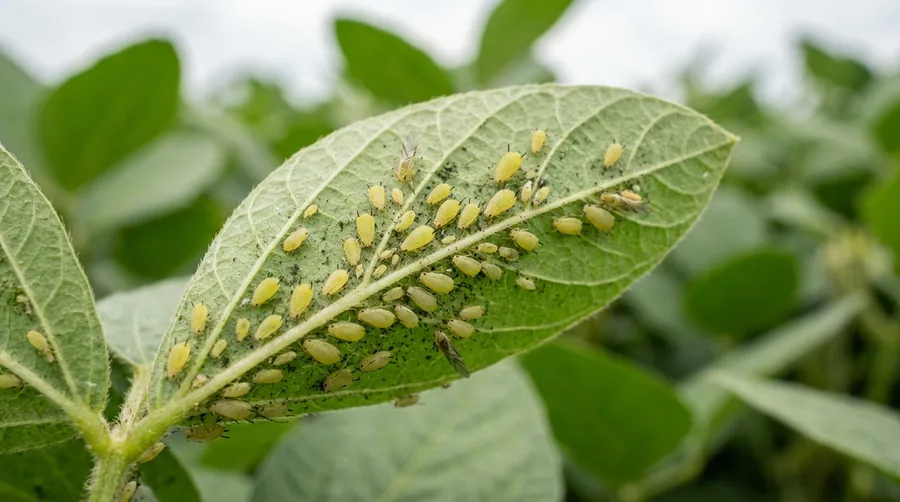
Tiny pale yellow-green soybean aphids clustered on the underside of a soybean leaf
Recommended Products


What it does
Soybean aphids feed by piercing plant tissue and drawing sap, forming dense colonies on new growth and leaf undersides. Their feeding stunts plants and reduces pods and yield, while the sticky honeydew they excrete promotes black sooty mold that further limits photosynthesis.
Where it lives
This is a field-crop pest of soybeans across the Midwest and northern soybean-growing states. It overwinters as eggs on buckthorn (Rhamnus) shrubs, then winged aphids move to soybean fields in early summer. It is not a household or indoor pest.
How it breeds
Through the growing season, wingless females reproduce asexually, giving live birth without mating, so colonies explode within days. Many overlapping generations build up over summer. In fall, winged forms return to buckthorn, where mated females lay overwintering eggs.
What it eats
Soybean aphids feed almost exclusively on the sap of soybean plants during summer, and on buckthorn shrubs, their overwintering host, in fall and spring.
Identification
Adults are only 1-2 mm, soft-bodied, and pale yellow to yellow-green, with two dark tube-like cornicles ('tailpipes') at the rear. Colonies of many small aphids on stems and leaf undersides, plus shiny honeydew, are the easiest field clue.
Signs of an infestation
- Dense colonies of tiny pale aphids on leaf undersides and stems
- Sticky, shiny honeydew coating leaves
- Black sooty mold growing on the honeydew
- Curled, puckered, or stunted new growth
- Ants tending aphid colonies for honeydew
Prevention tips
- Scout fields regularly and use university economic thresholds before spraying
- Encourage natural enemies like lady beetles and parasitic wasps
- Remove nearby buckthorn, the overwintering host, where practical
- Plant aphid-resistant soybean varieties where available
- Avoid unnecessary insecticide that kills beneficial predators
Professional solutions
Because it is a field-scale crop pest, control decisions are best made with a local extension agent or agronomist who can confirm the pest and check whether populations exceed the treatment threshold (commonly around 250 aphids per plant). They can advise on labeled insecticides and timing to protect yield and beneficial insects.
Health & safety
Soybean aphids do not bite, sting, or spread any disease to people or pets, so they pose no household health risk. The 'disease' concern is agricultural: they can transmit plant viruses such as soybean mosaic virus between plants, which affects crops, not humans.
Relevant Products


Frequently asked questions
Are soybean aphids harmful to people?
No. Soybean aphids do not bite, sting, or carry any human disease. They are strictly a crop pest that damages soybean plants by sucking sap. The only concern is agricultural yield loss, not household health.
Where do soybean aphids come from each year?
They overwinter as eggs on buckthorn shrubs, then winged aphids fly to soybean fields in early summer. Populations build asexually through the season and return to buckthorn in fall to lay overwintering eggs.
Fact-checked by Morgan Vance, Editorial Director (editorial review, not a professional pest-control or medical sign-off). Last reviewed May 27, 2026. We correct anything a reader shows us is wrong — see our corrections policy.