
Scabies Mite
Sarcoptes scabiei · also called human itch mite, scabies, mange mite
Quick answer
The scabies mite (Sarcoptes scabiei var. hominis) is a microscopic mite that burrows into the top layer of human skin to lay eggs, causing scabies: intense itching and a pimple-like rash. It spreads through prolonged skin-to-skin contact between people and requires prescription treatment from a doctor, not household pesticides.
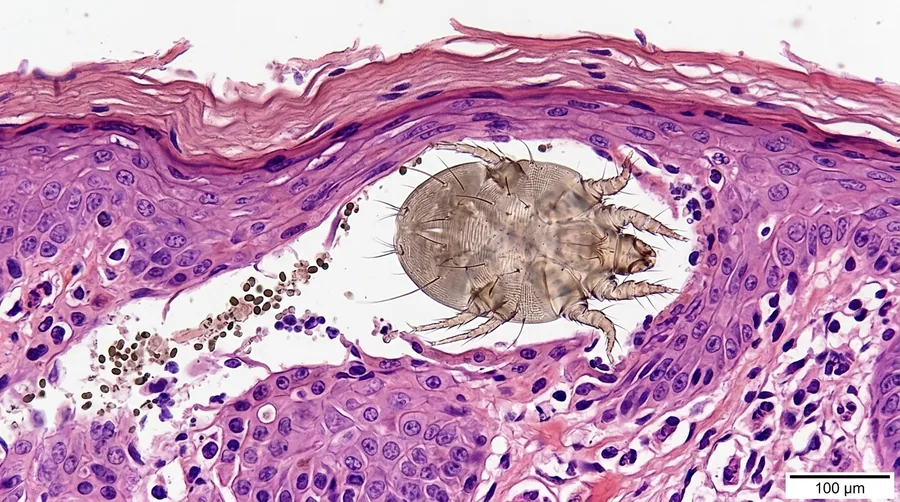
Microscope-style close-up of a rounded scabies mite in a skin burrow surrounded by irritated skin
Recommended Products


What it does
Female scabies mites tunnel into the outer skin, laying eggs as they burrow. The intense itching of scabies is an allergic reaction to the mites, their eggs, and waste. Mites move from person to person through prolonged direct skin contact, which is why scabies spreads within households and close-contact settings.
Where it lives
This mite is a human parasite that lives in and on human skin, favoring warm folds and thin-skinned areas: between fingers, the wrists, elbows, waistline, and groin. Off a human host, mites typically survive only 2-3 days, so bedding and clothing play a minor secondary role in spread.
How it breeds
A burrowing female lays two to three eggs a day for several weeks. Eggs hatch in three to four days, and larvae move to the skin surface, mature, and mate; females then burrow to begin the cycle. Symptoms can take four to six weeks to appear after a first infestation.
What it eats
Scabies mites feed on dissolved skin tissue and fluid within the outer layer of human skin as they burrow. They do not feed on blood or on household materials.
Identification
The mite itself is microscopic and rarely seen; a doctor diagnoses scabies from the rash, burrow lines, and itching, sometimes confirmed by skin scraping. Signs include thin, thread-like burrow tracks and small red bumps in the finger webs, wrists, and other typical sites.
Signs of an infestation
- Intense itching that is typically worse at night
- Pimple-like rash or small red bumps
- Thin, thread-like burrow tracks on the skin
- Rash concentrated in finger webs, wrists, elbows, and waistline
- Multiple household or close contacts itching around the same time
Prevention tips
- Avoid prolonged skin-to-skin contact with an infested person until treated
- Treat all household members and close contacts at the same time
- Wash bedding, clothing, and towels in hot water and hot-dry them
- Seal non-washable items in a plastic bag for at least 72 hours
- Follow a doctor's instructions on prescription treatment exactly
Professional solutions
Scabies is a medical condition, not a household pest-control job. See a doctor or dermatologist, who can confirm the diagnosis and prescribe treatment such as permethrin cream or oral ivermectin. Over-the-counter insecticides and 'bug bombs' do not treat scabies and are not appropriate for skin.
Health & safety
Scabies causes intense itching and rash and is contagious through close contact, but it is treatable and not typically dangerous in healthy people. Scratching can lead to skin infection, and a severe form called crusted scabies can occur in those with weakened immunity. Prompt medical treatment resolves most cases.
Relevant Products


Frequently asked questions
Can I treat scabies with a household bug spray?
No. Scabies mites live in human skin, so treatment is a prescription medication applied to the body, such as permethrin cream or oral ivermectin, from a doctor. Household insecticides and foggers do not treat scabies and should never be used on skin.
How does scabies spread?
Mainly through prolonged, direct skin-to-skin contact with an infested person, which is why it spreads among household members, sexual partners, and in care settings. Shared bedding or clothing can play a minor role. Treating all close contacts at once helps prevent reinfestation.
Do I need to fumigate my house for scabies?
No. Mites rarely survive more than 2-3 days off a human host, so fumigation is unnecessary. Washing bedding, clothing, and towels in hot water and hot-drying them, or bagging non-washable items for at least 72 hours, is sufficient alongside the prescribed skin treatment.
Fact-checked by Morgan Vance, Editorial Director (editorial review, not a professional pest-control or medical sign-off). Last reviewed June 24, 2026. We correct anything a reader shows us is wrong — see our corrections policy.