
Muskrat
Ondatra zibethicus · also called muskrats, marsh rabbit, mud beaver
Quick answer
The muskrat (Ondatra zibethicus) is a large, semiaquatic rodent with dense brown fur, partly webbed hind feet, and a long, scaly, flattened tail. It lives in ponds, marshes, and streams, burrowing into banks and dams. Muskrat tunneling damages levees and shorelines, and they can carry waterborne disease.
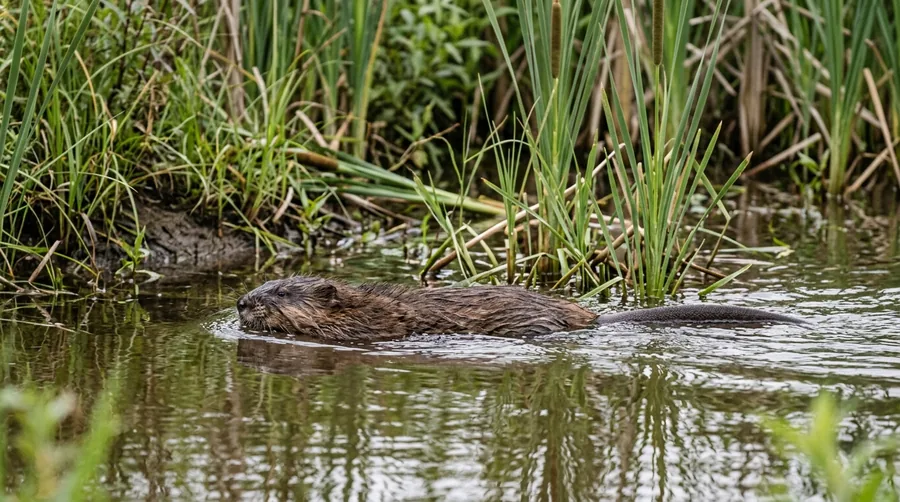
Brown muskrat with a long, flattened scaly tail swimming at the edge of a pond
Recommended Products


What it does
Muskrats are semiaquatic rodents that swim well using partly webbed hind feet and a long, flattened tail as a rudder. Mostly active at dawn, dusk, and night, they burrow into banks and dams or build dome-shaped lodges of vegetation. Their burrowing undermines pond banks, levees, and dams, and they can damage crops and aquatic plantings.
Where it lives
They live in and around fresh and brackish water: marshes, ponds, lakes, streams, drainage ditches, and canals across most of the US. They den in bank burrows with underwater entrances or build vegetation lodges, and are drawn to farm ponds, retention basins, and levees, where their tunneling causes the most concern.
How it breeds
Muskrats are prolific, breeding several times from spring through summer, with litters of about four to seven young; in the South they may breed nearly year-round. Young mature within a season and disperse to establish their own dens. High reproductive rates let local populations build quickly where habitat and food are good.
What it eats
Muskrats feed mainly on aquatic vegetation such as cattails, bulrushes, sedges, and pondweeds, and also on roots, crops near water, and, at times, mussels, snails, frogs, and other small animals. Their heavy feeding on marsh plants and crops can damage plantings and shorelines.
Identification
A muskrat is a large rodent, about 10-14 inches in the body, with dense glossy brown fur, small ears, partly webbed hind feet, and a distinctive long, black, vertically flattened, scaly tail. The flattened tail and aquatic habits distinguish it from the larger, flat-tailed beaver and from ordinary rats.
Signs of an infestation
- Burrow entrances below the waterline in banks and levees
- Dome-shaped lodges of cattails and vegetation in marshes
- Slumping or eroding pond banks and dam faces from tunneling
- Cut and floating aquatic plants and feeding platforms
- Muskrats swimming at dawn or dusk with only the head showing
Prevention tips
- Protect pond banks and dams with buried wire mesh or riprap
- Manage shoreline vegetation that provides food and cover
- Maintain steep bank slopes that discourage burrowing
- Install barriers around vulnerable levees and water-control structures
- Monitor banks and dams regularly for early signs of digging
Professional solutions
Muskrats are regulated furbearers in most states, so trapping is legal only in certain seasons and with proper permits. Because of that and the risk to dams and levees, control is best handled by a licensed wildlife or nuisance-control professional who can trap lawfully, repair burrows, and protect water structures. Do not attempt unpermitted trapping or relocation.
Health & safety
Muskrats can carry diseases spread through water and contact, including tularemia, leptospirosis, and giardiasis, so avoid handling them and do not swim in heavily contaminated water. They may bite or scratch if cornered. The greater practical hazard is structural: their burrowing can weaken and breach pond dams and levees, causing flooding and costly damage.
Relevant Products




Frequently asked questions
What is the difference between a muskrat and a beaver?
Muskrats are much smaller, about the size of a large rat, with a thin, vertically flattened, scaly tail. Beavers are far larger with a broad, horizontally flattened, paddle-shaped tail. Both are aquatic, but muskrats burrow into banks and build small vegetation lodges rather than large stick dams.
Are muskrats dangerous?
They avoid people and rarely bite unless cornered, but they can carry waterborne diseases such as tularemia, leptospirosis, and giardiasis, so they should not be handled. The bigger practical danger is to property, since their burrowing can weaken pond dams and levees and cause flooding.
Can I trap a muskrat myself?
Usually only within legal limits. Muskrats are regulated furbearers in most states, so trapping is restricted to certain seasons and often requires a permit, and relocation may be prohibited. Because of that and the risk to dams and levees, a licensed wildlife professional is the safest, lawful choice.
Fact-checked by Morgan Vance, Editorial Director (editorial review, not a professional pest-control or medical sign-off). Last reviewed May 8, 2026. We correct anything a reader shows us is wrong — see our corrections policy.