
Masked Hunter
Reduvius personatus · also called masked hunter bug, masked bed bug hunter, assassin bug
Quick answer
The masked hunter (Reduvius personatus) is a shiny black assassin bug whose young camouflage in dust and lint. A beneficial predator of other insects, it enters homes drawn to lights and hunting prey. It does not seek people, but can deliver a painful bite if handled, so it is best left alone.
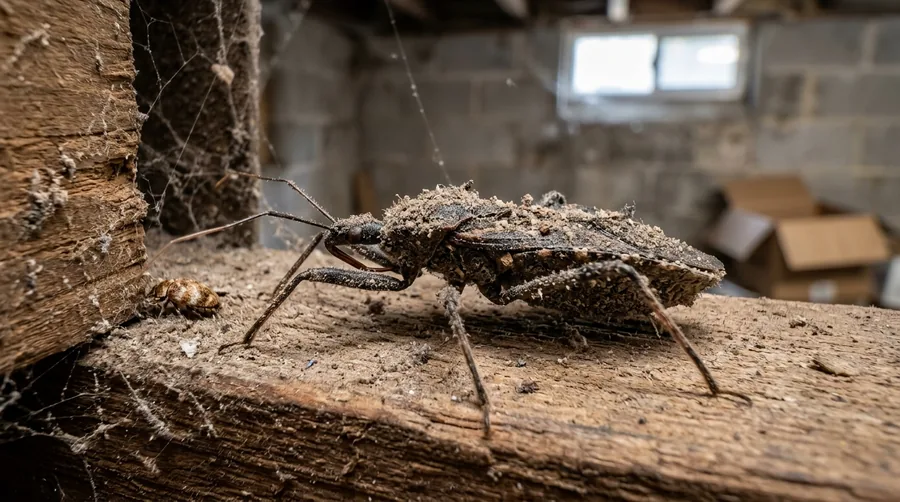
Shiny black masked hunter assassin bug with a narrow head and curved beak on a wall
Recommended Products


What it does
The masked hunter is a stealthy predator that stalks and stabs other insects with its curved beak. Nymphs cover themselves in dust, lint, and debris as camouflage, hence the name. Adults are attracted to lights and enter buildings while hunting prey such as bed bugs, carpet beetle larvae, and other insects. It is not a parasite of people.
Where it lives
It lives in and around barns, sheds, attics, wall voids, and cluttered, dusty spaces where its insect prey shelters. It is common in older homes and outbuildings across the US. Indoors it hunts along baseboards, in bedding areas, and near stored items, and is most noticed in late summer and fall.
How it breeds
There is typically one generation a year. Eggs are laid in cracks and sheltered spots; the debris-coated nymphs develop through several stages over the warm months, feeding on other insects, before maturing into winged adults. Adults are the stage most often seen entering living spaces.
What it eats
Masked hunters are predators, feeding on other insects including bed bugs, carpet beetle larvae, booklice, and various small arthropods. They do not feed on human blood, plants, or stored food; their presence usually signals other insect prey nearby.
Identification
Adults are elongated, shiny black to dark brown, about 17-22 mm, with a narrow head, long legs, and a stout curved beak (rostrum) folded under the body. Nymphs are the same shape but coated in dust and lint, appearing as a walking clump of debris. The tucked beak marks it as an assassin bug.
Signs of an infestation
- Shiny black elongated bugs indoors in late summer and fall
- Dust- and lint-covered nymphs moving along baseboards
- Bugs gathering near lights and windows at night
- Presence of other insect prey such as bed bugs or carpet beetles
- A sudden painful bite when a bug is unknowingly pressed against skin
Prevention tips
- Seal cracks, gaps, and screen vents to limit entry
- Reduce indoor clutter and dust where nymphs hide and hunt
- Address underlying prey infestations like bed bugs or carpet beetles
- Manage exterior lighting that draws adults to the house
- Never handle one bare-handed; capture with a cup and card instead
Professional solutions
The masked hunter itself rarely needs treatment, but its presence can indicate a prey infestation (such as bed bugs) worth a professional inspection. If bugs enter repeatedly, a pest professional can address the underlying prey, seal entry points, and apply EPA-registered products where appropriate. Removing the reason it is hunting indoors is the durable fix.
Health & safety
The masked hunter can inflict a bite that is notably painful, sometimes compared to a bee sting, with localized swelling and redness, but it does not seek people and bites only defensively when trapped or pressed against skin. Importantly, it is not a Chagas-disease vector. If a bite causes a severe or spreading reaction, or signs of allergic response, seek medical care; for symptom questions you can also call Poison Control at 1-800-222-1222.
Relevant Products




Frequently asked questions
Does a masked hunter bite hurt, and is it dangerous?
A masked hunter bite can be quite painful, often likened to a bee sting, with local swelling. It bites only defensively when handled or trapped against skin, not to feed on people. It is not a Chagas vector. Seek medical care if the reaction is severe, spreading, or allergic.
Why do I have masked hunter bugs in my house?
Masked hunters are predators that come indoors hunting other insects and are drawn to lights. Their presence often means prey is around, such as bed bugs or carpet beetles. Sealing entry points, reducing clutter and dust, and addressing any underlying insect infestation keeps them out.
Fact-checked by Morgan Vance, Editorial Director (editorial review, not a professional pest-control or medical sign-off). Last reviewed June 2, 2026. We correct anything a reader shows us is wrong — see our corrections policy.