
Iris Borer
Macronoctua onusta · also called iris borer
Quick answer
The iris borer (Macronoctua onusta) is the caterpillar of a night-flying moth and the most destructive pest of iris. Young larvae tunnel down leaves into the rhizome, hollowing it out and opening the door to bacterial soft rot. The adult moth is harmless; the damage comes from the boring larvae, harming plants, not people.
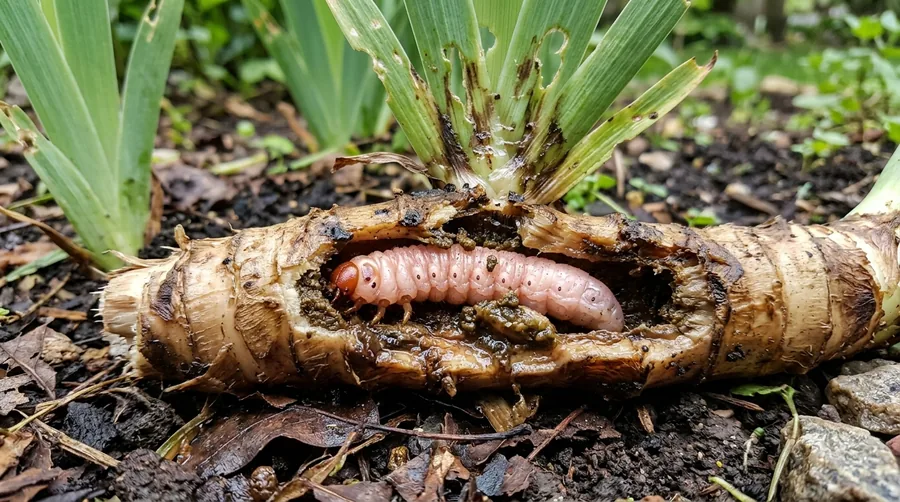
Fat pinkish iris borer caterpillar tunneling inside a hollowed iris rhizome
Recommended Products


What it does
Young larvae hatch in spring and chew into iris leaves, boring downward inside them and leaving water-soaked streaks and ragged notches. They tunnel into the rhizome and hollow it out. Their wounds frequently let in bacterial soft rot, which turns the rhizome to foul-smelling mush and can destroy the clump.
Where it lives
The iris borer lives on iris, especially bearded iris, in home flower beds and gardens, and also attacks Siberian and other irises. It is common across the eastern and central US and into the South, spending its destructive larval stage inside iris leaves and rhizomes at or below the soil line.
How it breeds
There is one generation per year. Eggs laid on old iris leaves and nearby debris in fall overwinter and hatch in spring. Larvae bore through leaves into rhizomes over early summer, then pupate in the soil. Dull brown adult moths emerge in late summer to fall to mate and lay the overwintering eggs.
What it eats
Larvae feed on iris tissue, first inside the leaves and then hollowing out the rhizome. The adult moth feeds little. The insect does not feed on anything indoors or on stored food.
Identification
The larva is a fat, pinkish caterpillar up to about two inches long with a brown head, found inside leaves or rhizomes. Early signs are water-soaked streaks and notched, chewed leaf margins. The night-flying adult is a nondescript dull brown moth about two inches across, rarely seen.
Signs of an infestation
- Water-soaked streaks and chewed notches on iris leaves
- Ragged, wilting leaf fans in early summer
- Hollowed, mushy, foul-smelling rhizomes (soft rot)
- Pinkish caterpillars found inside leaves or rhizomes
- Sudden collapse of an iris clump
Prevention tips
- Cut down and destroy old iris foliage and debris in fall to remove eggs
- Inspect leaves in spring and crush borers in the streaked tissue
- Divide and inspect rhizomes every few years, discarding damaged ones
- Keep beds clean and avoid heavy mulch over rhizomes
- Space and site iris in sun with good drainage to limit rot
Professional solutions
Good sanitation and hand-removal control most iris borer problems, so professionals are seldom needed. Where infestations are severe, a labeled insecticide timed to early-spring egg hatch, or systemic treatment, can be used per directions. A garden center or extension office can confirm timing for your area.
Health & safety
The iris borer and its moth do not bite, sting, or carry any human disease, and they never infest homes. The bacterial soft rot they trigger affects only plants. There is no risk to people or pets, just to the iris planting itself.
Relevant Products


Frequently asked questions
What is hollowing out my iris rhizomes?
Hollowed, mushy, foul-smelling iris rhizomes are the work of the iris borer, whose caterpillar tunnels down from the leaves into the rhizome. Its wounds usually trigger bacterial soft rot, which finishes the destruction. Look for a fat pinkish caterpillar inside affected tissue.
How do I prevent iris borer?
Fall sanitation is the key step: cut down and destroy old iris leaves and garden debris where the eggs overwinter. In spring, inspect for water-soaked streaks and crush any borers you find. Dividing and inspecting rhizomes every few years also helps.
Do I need to spray for iris borer?
Often not. Removing old foliage in fall and hand-crushing early larvae control most infestations. If borers are severe, a labeled insecticide timed to early-spring egg hatch can help. A local extension office can confirm the right timing for your region.
Fact-checked by Morgan Vance, Editorial Director (editorial review, not a professional pest-control or medical sign-off). Last reviewed August 11, 2026. We correct anything a reader shows us is wrong — see our corrections policy.