
Boxwood Leafminer
Monarthropalpus flavus · also called boxwood leaf miner
Quick answer
The boxwood leafminer (Monarthropalpus flavus) is a small orange gall midge whose larvae tunnel inside boxwood leaves, creating blister-like blotches. It is the most damaging insect pest of boxwood in the US. Adults briefly swarm like tiny gnats in spring; the hidden larvae cause the yellowing, blistering, and leaf drop, harming shrubs, not people.
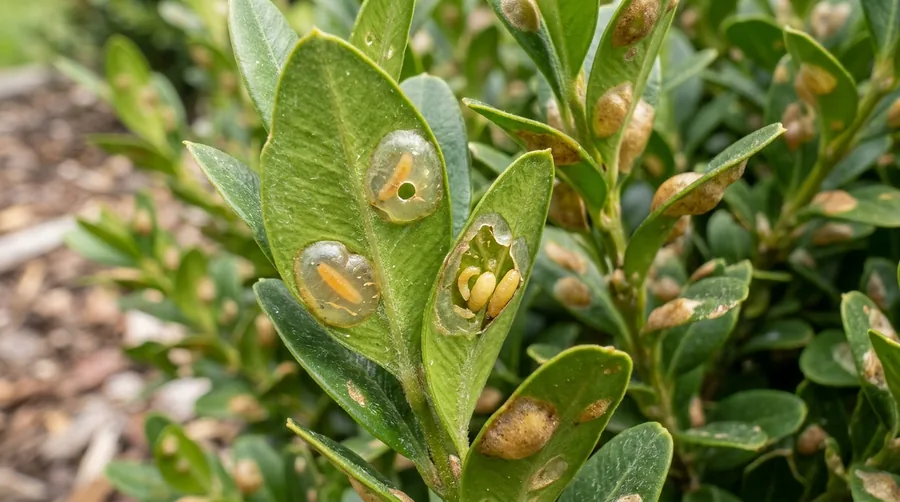
Boxwood leaves with yellow-brown blister mines caused by boxwood leafminer larvae
Recommended Products


What it does
Adult midges live only a day or two, mating and laying eggs inside new boxwood leaves in spring. The legless larvae feed within the leaf tissue all season and winter, hollowing out mines that show as raised blisters. Their feeding weakens the shrub and causes premature leaf drop.
Where it lives
The boxwood leafminer lives entirely on boxwood (Buxus species) in landscapes, hedges, and foundation plantings. American boxwood is highly susceptible while some English and littleleaf cultivars resist it. It is found across the US wherever boxwood is grown as an ornamental.
How it breeds
There is one generation per year. Adults emerge over a few days in spring, often as leaves flush, and insert eggs into the underside of new leaves. Larvae feed and grow inside the leaf through summer, overwinter there, pupate in spring, and emerge as adults, completing the cycle.
What it eats
Larvae feed only on the inner tissue of boxwood leaves, mining out the soft green layer between the leaf surfaces. Adults do not feed meaningfully during their short life.
Identification
Adults are delicate, orange-yellow, mosquito-like midges about 2.5 mm that swarm briefly in spring. The real evidence is on the leaves: blister-like, yellow to brown blotches on the underside, each holding one or more small yellow-orange maggots visible if the blister is opened.
Signs of an infestation
- Raised blister-like mines on the underside of leaves
- Yellow, tan, or brown blotches on boxwood foliage
- Premature leaf drop and thin, sparse shrubs
- Brief clouds of tiny orange flies around boxwoods in spring
- Small maggots inside opened leaf blisters
Prevention tips
- Choose resistant boxwood cultivars when planting
- Keep shrubs vigorous with proper watering and mulch
- Prune and destroy heavily mined foliage in early spring before adults emerge
- Monitor leaf undersides in spring for new blisters
- Avoid stressing plants with drought or heavy shearing
Professional solutions
Light infestations are mostly cosmetic and tolerated. For heavy, recurring damage, professionals time treatments to the short spring adult emergence or apply a systemic insecticide taken up by the leaves, following label directions. A landscaper can help match spray timing to local emergence.
Health & safety
Boxwood leafminer poses no risk to people or pets: it does not bite, sting, or spread human disease, and it feeds only on boxwood. The impact is limited to the appearance and health of the shrubs themselves.
Relevant Products




Frequently asked questions
What causes blisters on boxwood leaves?
Blister-like bumps and yellow-brown blotches on boxwood leaves are typically boxwood leafminer. The larvae of this small midge feed inside the leaf, hollowing out the tissue. Opening a blister usually reveals a tiny yellow-orange maggot, which confirms the pest.
When should I treat for boxwood leafminer?
Timing matters because there is one generation a year. Treatments target the brief spring adult emergence, often as new leaves flush, or use a systemic product taken up by the foliage. A local extension office or landscaper can pinpoint emergence timing for your area.
Will boxwood leafminer kill my shrubs?
It rarely kills established boxwood outright, but heavy, repeated infestations cause leaf drop, thinning, and stress that weaken shrubs over time. Choosing resistant cultivars and keeping plants healthy usually keeps damage cosmetic rather than fatal.
Fact-checked by Morgan Vance, Editorial Director (editorial review, not a professional pest-control or medical sign-off). Last reviewed May 25, 2026. We correct anything a reader shows us is wrong — see our corrections policy.