
Boxwood Psyllid
Cacopsylla busi · also called boxwood psyllid, Psylla buxi
Quick answer
The boxwood psyllid (Cacopsylla busi) is a small greenish, aphid-like jumping insect whose nymphs suck sap from new boxwood growth, causing the leaves to cup or spoon inward. Nymphs shield themselves in white waxy threads. Damage is mostly cosmetic, and this is the most common boxwood pest, harming the shrubs' looks rather than people.
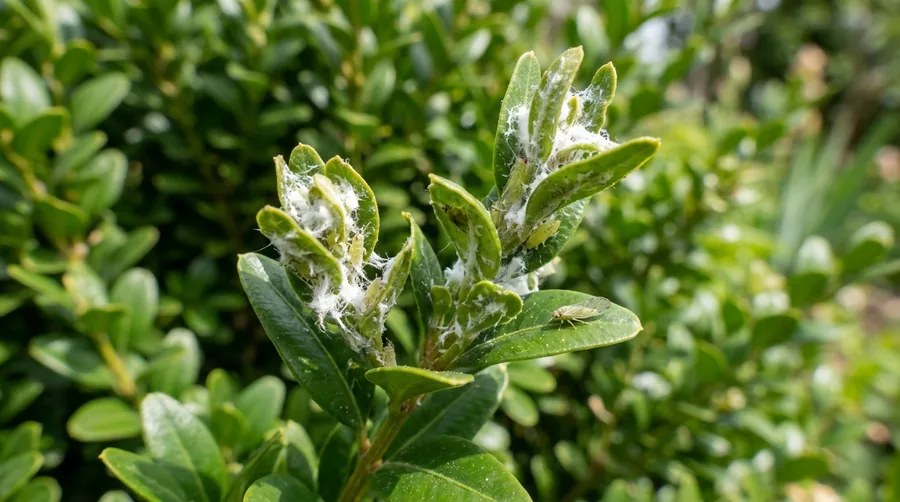
Cupped boxwood leaves with white waxy filaments from feeding boxwood psyllid nymphs
Recommended Products


What it does
Nymphs hatch in spring and feed on expanding boxwood buds and leaves, injecting saliva that makes the leaves cup around them for protection. They cover themselves in white, waxy filaments. Adults are winged and jump or fly when disturbed. Feeding stunts new shoots but rarely threatens the whole plant.
Where it lives
The boxwood psyllid feeds only on boxwood (Buxus species), especially American boxwood, in hedges, foundation plantings, and formal gardens. It is the most widespread boxwood insect in the US and is found across the country wherever the shrubs are grown.
How it breeds
There is one generation per year. Eggs overwinter under bud scales and hatch as buds open in spring. Nymphs pass through several stages while feeding in the cupped leaves, then mature into winged adults by early summer. Adults lay the overwintering eggs, completing the annual cycle.
What it eats
Both nymphs and adults feed on boxwood sap, drawn mainly from tender new growth. They do not feed on other plants or on any household materials.
Identification
Adults are pale gray-green, about 3-4 mm, and resemble tiny cicadas that jump readily. Nymphs are green, flattened, and coated in white wax inside cupped leaves. The tell-tale sign is boxwood tips whose leaves are cupped or spooned around the feeding nymphs.
Signs of an infestation
- New boxwood leaves cupped or spooned inward
- White waxy threads on tender shoot tips
- Small green nymphs tucked inside cupped leaves
- Stunted, distorted new growth in spring
- Tiny insects that jump when the shrub is disturbed
Prevention tips
- Tolerate light damage, which is largely cosmetic
- Choose less-susceptible boxwood cultivars where possible
- Prune out cupped tips in spring to remove nymphs
- Encourage predators such as lady beetles and lacewings
- Keep shrubs healthy with adequate water and mulch
Professional solutions
Boxwood psyllid seldom needs chemical control because damage is cosmetic and the plant outgrows it. Where appearance matters, a professional may apply horticultural oil or an insecticide timed to egg hatch in spring, following the label. Pruning affected tips is often enough on its own.
Health & safety
The boxwood psyllid does not bite or sting people, does not infest homes, and spreads no human disease. It only affects the appearance of boxwood shrubs, so there is no health risk to people or pets.
Relevant Products




Frequently asked questions
Why are my boxwood leaves cupped?
Cupped or spooned boxwood leaves in spring are the classic sign of boxwood psyllid. The nymphs feed inside the new growth and cause the leaves to curl around them. Peeling open a cupped tip usually reveals small green nymphs coated in white wax.
Is boxwood psyllid damage serious?
Usually not. The leaf cupping is cosmetic and mainly affects new spring growth; established boxwoods tolerate it and keep growing. Many gardeners simply prune affected tips. Treatment is only worthwhile where the shrubs' formal appearance is important.
How do I control boxwood psyllid without chemicals?
Prune out the cupped, infested shoot tips in spring to physically remove nymphs, and encourage natural predators like lady beetles and lacewings. Keeping shrubs healthy helps them outgrow the damage. A strong spray of water can dislodge some nymphs too.
Fact-checked by Morgan Vance, Editorial Director (editorial review, not a professional pest-control or medical sign-off). Last reviewed July 14, 2026. We correct anything a reader shows us is wrong — see our corrections policy.