
Horn Fly
Haematobia irritans · also called horn flies, cattle fly
Quick answer
Horn flies (Haematobia irritans) are small blood-feeding flies about half the size of a house fly that cluster on the backs and bellies of cattle. Both sexes bite many times a day, causing weight loss and reduced milk output. They breed almost exclusively in fresh cattle manure, making them a costly livestock pest.
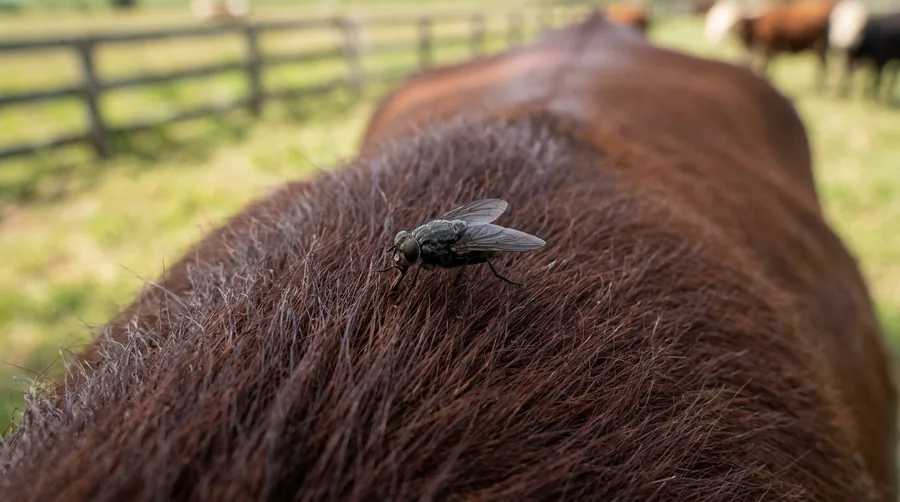
Small dark horn flies clustered on the back of a cow feeding on the animal
Recommended Products



What it does
Horn flies spend almost their entire adult life on cattle, clustering by the hundreds on the back, shoulders, and belly and leaving only briefly to lay eggs. Both sexes bite repeatedly, taking many small blood meals a day. Heavy loads make cattle bunch, stamp, and swish constantly, reducing grazing and weight gain.
Where it lives
Adults live on the host animal, mainly beef and dairy cattle on pasture. Females lay eggs in very fresh cattle manure, which is the only significant breeding site. Horn flies are found wherever cattle are raised across the US and are among the most economically damaging livestock pests.
How it breeds
Females leave the animal briefly to lay eggs in fresh manure pats. Larvae develop in the dung, then pupate in the soil beneath. In warm weather the cycle takes about one to two weeks, producing many rapid, overlapping generations and large populations through the grazing season.
What it eats
Both male and female horn flies feed on the blood of cattle, biting many times daily. They occasionally feed on other large animals nearby. The larvae feed and develop within fresh cattle manure.
Identification
Horn flies are small, 3-4 mm, roughly half the length of a house fly, dark gray, with forward-projecting piercing mouthparts. They are recognized less by close-up features than by their behavior: dense clusters riding on the backs and bellies of cattle, heads pointed downward.
Signs of an infestation
- Dense clusters of small flies on cattle backs and bellies
- Cattle bunching, stamping, and tail-switching
- Reduced grazing time and slower weight gain
- Flies remaining on animals rather than resting elsewhere
- Lower milk production in dairy herds
Prevention tips
- Use labeled insecticide ear tags, dusts, or pour-ons on cattle
- Provide dust bags or oilers at gates and water sources
- Break up manure pats by dragging pastures
- Rotate insecticide classes to slow resistance
- Work with a veterinarian on a herd fly program
Professional solutions
Horn fly management is a livestock-production task rather than a household one. Producers use insecticide ear tags, pour-ons, dust bags, and feed-through larvicides, ideally rotating chemistries to limit resistance. A veterinarian or livestock extension specialist can design an economical program tailored to the herd and region.
Health & safety
Horn flies rarely bite people and are not a significant human disease vector. Their impact is economic and animal-welfare related: heavy biting stresses cattle, causes blood loss, and lowers weight gain and milk production, and can contribute to skin conditions. For people, they are an incidental farm nuisance with no meaningful health risk.
Relevant Products


Frequently asked questions
What are the small flies covering my cattle's backs?
They are most likely horn flies, small dark blood-feeding flies that live on cattle and cluster by the hundreds on the back and belly. Both sexes bite constantly, which stresses the animal and cuts weight gain and milk output, making them a costly livestock pest.
How do I control horn flies on cattle?
Use labeled insecticide ear tags, pour-ons, dust bags, or feed-through larvicides, and rotate chemistries to slow resistance. Dragging pastures to break up manure pats reduces breeding sites. A veterinarian or extension livestock specialist can build an effective, economical program.
Do horn flies bite people?
Horn flies overwhelmingly stay on cattle and rarely bite people, and they are not a significant human health risk. Their importance is economic, through blood loss, stress, and reduced production in beef and dairy herds, rather than any danger to humans.
Fact-checked by Morgan Vance, Editorial Director (editorial review, not a professional pest-control or medical sign-off). Last reviewed July 15, 2026. We correct anything a reader shows us is wrong — see our corrections policy.