Holly Leafminer
Phytomyza ilicicola · also called holly leaf miner, native holly leafminer
Quick answer
The holly leafminer (Phytomyza ilicicola) is a tiny black fly whose larvae tunnel inside holly leaves, leaving yellow and brown serpentine or blotch mines. Damage is cosmetic, disfiguring the evergreen foliage prized on American and English holly. It weakens heavily infested shrubs but harms neither people nor the structure of a home.
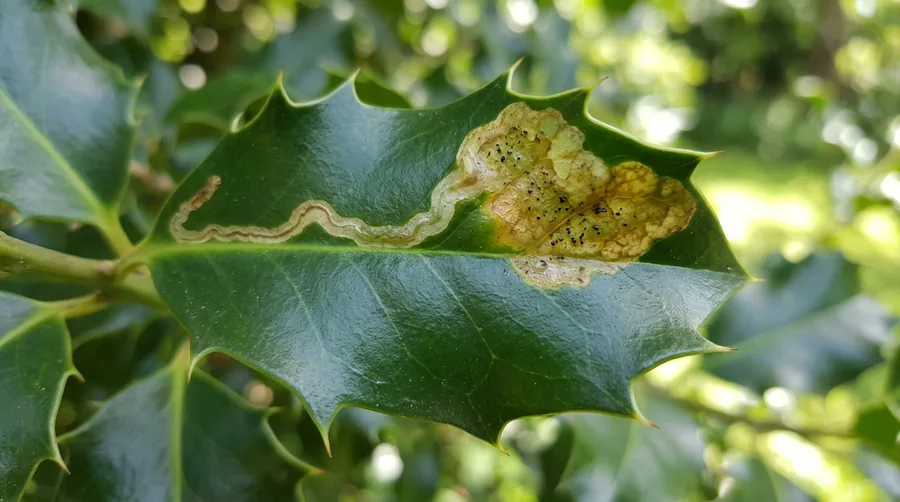
Holly leaf showing yellow and brown winding leafminer trails made by fly larvae
Recommended Products


What it does
Adult flies puncture new holly leaves to feed and lay eggs, and the maggots mine inside the leaf all season, widening the tunnels as they grow. On evergreen holly the disfiguring mines stay visible year-round because the leaves persist. Feeding is cosmetic and rarely threatens an established shrub.
Where it lives
It lives on holly, particularly American holly and English holly, in landscapes, hedges, and foundation plantings. Different but similar Phytomyza species occur across US holly-growing regions. The insect stays on the plant and never infests the home.
How it breeds
There is generally one generation a year. Adults emerge in spring as new growth appears, lay eggs in tender leaves, and the larvae mine through summer and fall, overwintering inside the leaf before pupating. Adults are active only for a few weeks in spring.
What it eats
Larvae feed on the inner leaf tissue of holly, creating the mines. Adult females also make tiny feeding punctures in leaves, which appear as small pale dots.
Identification
Adults are small, hunched black flies only 1.5-2 mm long. The larvae are pale yellow maggots inside the leaf. The clearest identifier is the mine itself: yellow to brown winding or blotchy tunnels on holly leaves, sometimes with a raised blister.
Signs of an infestation
- Yellow to brown winding trails or blotches in holly leaves
- Tiny pale feeding dots on new spring foliage
- Raised, blistered patches on leaves
- Small pale maggots inside mined leaves
- Persistent disfigured leaves through winter on evergreen holly
Prevention tips
- Rake up and dispose of fallen, mined leaves
- Prune out heavily mined branches to reduce numbers
- Keep holly healthy with adequate water and mulch
- Inspect new growth in spring when adults are active
- Choose less-susceptible holly varieties when planting
Professional solutions
Light infestations are usually tolerated as cosmetic. For valued specimens, an arborist may apply a systemic insecticide timed to spring adult activity, since the mining larvae are protected from contact sprays. Follow the EPA-registered product label for holly and observe re-entry and pollinator precautions.
Health & safety
The holly leafminer is harmless to humans and pets. It does not bite, sting, or transmit disease. Its only effect is disfiguring holly foliage, which is an aesthetic and plant-vigor concern rather than a health or structural one.
Relevant Products




Frequently asked questions
What makes the squiggly lines on my holly leaves?
Those winding yellow-to-brown trails are mines made by holly leafminer larvae feeding inside the leaf. The adult is a tiny black fly that lays eggs in spring; the maggots then tunnel through the leaf tissue for the rest of the season.
Should I treat holly leafminer?
Often no. The damage is cosmetic and healthy holly tolerates it well. If a specimen shrub is badly disfigured, an arborist can apply a systemic insecticide timed to spring adult activity, since contact sprays cannot reach larvae inside the leaf.
Fact-checked by Morgan Vance, Editorial Director (editorial review, not a professional pest-control or medical sign-off). Last reviewed May 17, 2026. We correct anything a reader shows us is wrong — see our corrections policy.