
Birch Leafminer
Fenusa pusilla · also called birch leaf miner, birch leafmining sawfly
Quick answer
The birch leafminer (Fenusa pusilla) is the larva of a small non-stinging sawfly introduced from Europe. Larvae tunnel inside birch leaves, hollowing out brown blotch mines that make foliage look scorched by early summer. The damage is mostly cosmetic but repeated attacks stress birches. It poses no risk to people or homes.
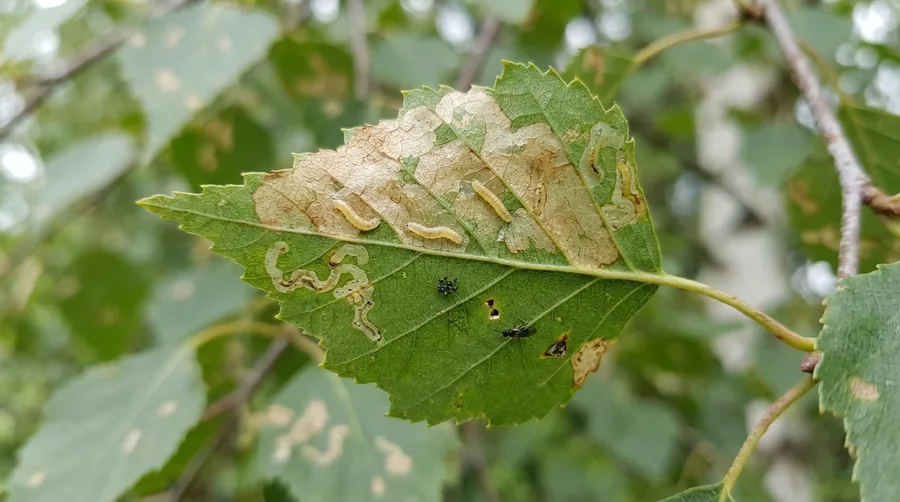
Birch leaves with brown blotchy mines caused by birch leafminer larvae inside
Recommended Products


What it does
Adult sawflies lay eggs into new birch leaves, and the larvae feed inside the leaf tissue between the upper and lower surfaces. This mining creates pale patches that quickly turn brown and papery. Because larvae live inside the leaf, the damage is protected from contact sprays and predators.
Where it lives
It attacks birches, especially gray, paper, and European white birch, in yards, parks, and street plantings. Introduced from Europe, it is now common across the northern US. It lives entirely on the trees and does not enter or infest homes.
How it breeds
There are usually two to four generations a year. Adults emerge in spring as new leaves flush, insert eggs into tender young foliage, and larvae mine for one to two weeks before dropping to pupate in the soil. Each new leaf flush can be attacked by a fresh generation.
What it eats
Larvae eat the soft inner tissue (mesophyll) of young birch leaves. They only attack fresh, tender growth, so older, hardened leaves are usually spared. Adults do little or no feeding.
Identification
Adults are shiny black, non-stinging sawflies about 3 mm long, easily mistaken for tiny flies. Larvae are flat and whitish, up to 6 mm, visible if a mined leaf is held to the light. The tell-tale sign is irregular brown blotch mines on new birch leaves.
Signs of an infestation
- Irregular brown or tan blotches inside birch leaves
- New leaves scorched-looking by early summer
- Whitish larvae visible when leaves are backlit
- Damage concentrated on fresh, tender growth
- Repeated browning after each new leaf flush
Prevention tips
- Keep birches watered and mulched to reduce stress
- Rake and remove fallen leaves to lower local numbers
- Choose resistant birch species like river birch when planting
- Avoid unnecessary pruning that pushes tender new growth
- Monitor new leaves in spring so treatment can be timed early
Professional solutions
Because larvae feed inside the leaf, contact sprays are ineffective. An arborist may use a systemic insecticide (such as a soil-applied product) that moves into the leaf tissue, timed to early spring egg-laying. For otherwise healthy trees, many homeowners simply tolerate the cosmetic damage. Follow all EPA label directions for any product used.
Health & safety
Birch leafminers are harmless to people and pets. They do not bite, sting, or spread disease, and the adult sawflies cannot sting despite the family name. The only impact is cosmetic browning of birch foliage and, over repeated heavy years, added stress to the tree.
Relevant Products




Frequently asked questions
Do birch leafminers kill birch trees?
Rarely on their own. The mining is mostly cosmetic, browning the foliage. Repeated heavy infestations add stress that, combined with drought or borers, can weaken a birch, so keeping the tree healthy and watered matters more than the leafminer itself.
Why don't sprays stop my birch leafminer?
The larvae feed inside the leaf, shielded from contact sprays. Effective control uses a systemic product that moves into the leaf tissue, timed to spring egg-laying. An arborist can apply this correctly; otherwise the damage is usually tolerated as cosmetic.
Fact-checked by Morgan Vance, Editorial Director (editorial review, not a professional pest-control or medical sign-off). Last reviewed May 19, 2026. We correct anything a reader shows us is wrong — see our corrections policy.