
Grain Mite
Acarus siro · also called grain mites, flour mite, mold mite
Quick answer
The grain mite (Acarus siro) is a microscopic, pale, soft-bodied mite that thrives in damp stored grain, flour, and cheese. Large populations form a moving 'mite dust' and give off a minty smell. Contact can cause an itchy rash known as grocer's itch, and it contaminates food rather than spreading disease.
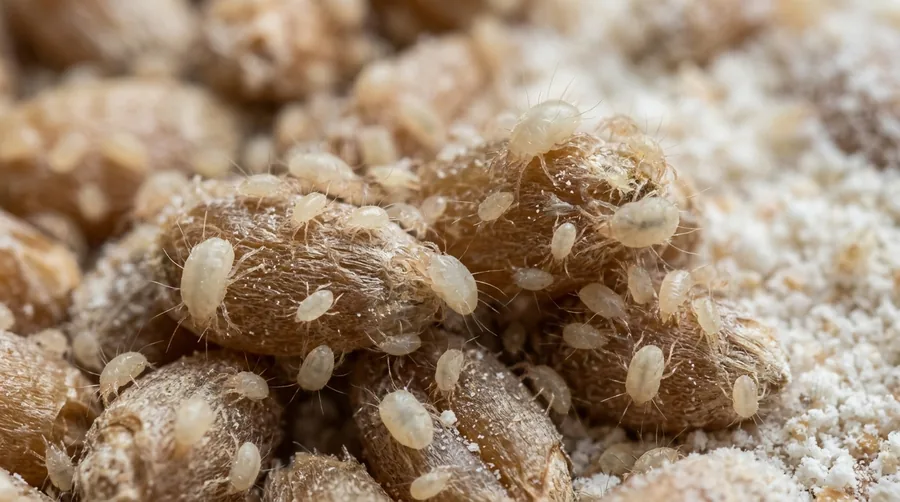
Microscopic pale soft-bodied grain mites forming a fine dust on damp stored flour
Recommended Products


What it does
Grain mites are moisture-loving scavengers that feed on grain germ, mold, and other damp organic matter. Under high humidity they multiply explosively, forming a moving powder over surfaces. Heavy populations leave a brownish 'mite dust' of bodies and shed skins and produce a distinctive sweet, minty odor.
Where it lives
They live in damp stored grain, flour, cereal, cheese, and other high-moisture foods in granaries, mills, warehouses, and occasionally homes. They require higher moisture than most stored-product insects, so infestations signal damp, poorly ventilated storage. They occur nationwide wherever such conditions exist.
How it breeds
Reproduction is extremely fast in warm, humid conditions, with the full cycle from egg to adult sometimes finishing in one to two weeks. Under stress, some develop into a specialized dispersal stage that clings to insects or equipment to spread. Populations can explode and then crash as food dries or is depleted.
What it eats
Grain mites feed on the germ of grains, on molds and fungi, and on damp flour, cereal, cheese, dried fruit, and similar high-moisture foods. Their reliance on dampness ties them closely to grain that has been stored too wet or in humid conditions.
Identification
Individual mites are microscopic, whitish, and soft-bodied with pale legs, essentially invisible without magnification. They are recognized instead by their effects: a fine, slowly shifting dust, a grayish or brownish film on food, and a telltale minty smell in heavy infestations.
Signs of an infestation
- Fine, slowly moving dust over stored food or shelves
- A sweet, minty odor near infested grain or flour
- Grayish or brownish film on grain, flour, or cheese
- Itchy skin (grocer's itch) after handling infested food
- Damp, musty stored grain that seems to shift or crawl
Prevention tips
- Keep grain and flour dry and store at low humidity
- Use dehumidification and ventilation in storage areas
- Store food in airtight containers and rotate stock
- Discard damp, moldy, or long-stored susceptible foods
- Clean and dry bins and shelves before restocking
Professional solutions
Reducing moisture and discarding infested food resolves most situations. For granaries, mills, and food facilities, professionals combine grain drying, aeration, sanitation, and, where warranted, approved treatments, since grain-mite outbreaks are fundamentally a moisture-management problem in bulk storage.
Health & safety
Grain mites do not bite in the way insects do, but handling heavily infested food can cause an itchy skin rash called grocer's or baker's itch, and their debris can trigger allergic or respiratory reactions in sensitive people. They are not disease vectors; infested food should be discarded, not eaten.
Relevant Products


Frequently asked questions
Why does my flour smell minty and seem to move?
A sweet, minty odor and a fine dust that appears to shift are classic signs of a heavy grain-mite infestation. The mites are microscopic, so you see the moving mass and smell them rather than individual mites. The food is contaminated and should be discarded.
Can grain mites make you itch or sick?
Handling badly infested food can cause an itchy skin rash known as grocer's itch, and mite debris can trigger allergic or breathing reactions in sensitive people. They are not known to spread disease, but you should not eat infested food.
How do I get rid of grain mites?
Because they need dampness, the key is moisture control: discard infested foods, dry and ventilate the storage area or use a dehumidifier, and store dry goods in airtight containers. Cleaning and drying bins and shelves before restocking prevents them from returning.
Fact-checked by Morgan Vance, Editorial Director (editorial review, not a professional pest-control or medical sign-off). Last reviewed July 25, 2026. We correct anything a reader shows us is wrong — see our corrections policy.