Four Lined Plant Bug
Poecilocapsus lineatus · also called four-lined plant bug, fourlined plant bug
Quick answer
The four-lined plant bug (Poecilocapsus lineatus) is a bright yellow-green true bug marked with four black stripes down its wings. It feeds on herbs, perennials, and many ornamentals, leaving rows of dark, sunken spots that can look like disease. Damage is mostly cosmetic, and the bug appears in one short generation each year.
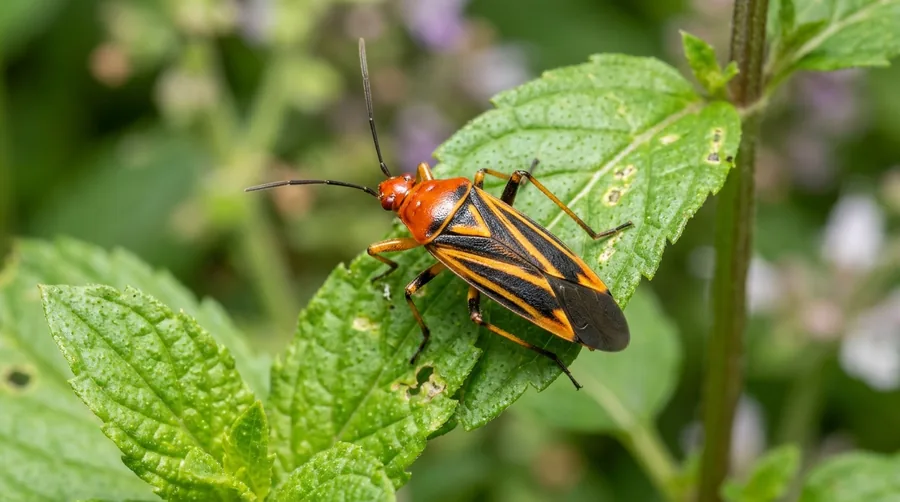
Bright yellow-green four lined plant bug with four black stripes on its wings resting on a mint leaf
Recommended Products


What it does
Adults and nymphs pierce leaf tissue and feed on sap, injecting enzymes that kill small patches of cells and leave round, dark, sunken spots that later turn translucent or drop out. Because the spots line up in the direction of feeding, the damage is often mistaken for a leaf-spot fungus. The bugs are quick and drop or dart away when approached.
Where it lives
Four-lined plant bugs are common in eastern and midwestern US gardens on a wide range of herbs, perennials, and shrubs. They favor mints, basil, oregano, and many ornamental perennials and are most noticeable in late spring and early summer along garden beds and borders.
How it breeds
There is a single generation per year. Females insert eggs into slits in the stems of host plants, where they overwinter. Eggs hatch in spring into bright reddish-orange nymphs with black wing pads; the nymphs mature to adults over several weeks, and by midsummer the adults die off, ending the season's activity.
What it eats
This bug feeds on the sap of a very broad plant list, especially herbs such as mint, basil, oregano, and lavender, plus many perennials, ornamentals, and soft-stemmed shrubs like currant.
Identification
Adults are about 7 mm, oval, and bright yellow-green to yellow with four black longitudinal stripes on the wings and reddish antennae. Nymphs are bright red to orange with black spots and no full wings. The lined adult and vivid red nymph are distinctive once you know them.
Signs of an infestation
- Rows of round, dark, sunken spots on leaves
- Spots that turn translucent, papery, or fall out
- Damage on herbs and perennials mistaken for leaf-spot disease
- Bright yellow-green striped bugs that dart or drop when disturbed
- Reddish-orange spotted nymphs on new growth in spring
Prevention tips
- Cut back and clean up host-plant stems in fall to remove overwintering eggs
- Scout herbs and perennials closely in late spring for early nymphs
- Knock nymphs into soapy water while populations are small
- Encourage general predators by avoiding broad-spectrum sprays
- Tolerate light spotting, since damage is largely cosmetic and brief
Professional solutions
Because there is only one short generation and the damage is mostly cosmetic, most gardeners need no more than handpicking, a strong water spray, or insecticidal soap on nymphs. Professional help is rarely warranted; if leaf spotting is confusing, your Cooperative Extension office can distinguish plant-bug feeding from a true leaf disease.
Health & safety
The four-lined plant bug does not bite people, sting, or carry human disease, so it is harmless to handle. Its impact is limited to plant appearance: the dark sunken spots blemish herbs and ornamentals but seldom threaten plant health, making it more of a cosmetic nuisance than a serious pest.
Relevant Products


Frequently asked questions
Are the dark spots on my mint from a disease or a bug?
Rows of round, dark, sunken spots on mint, basil, or perennials are often mistaken for leaf-spot fungus but are usually caused by the four-lined plant bug feeding. Look for a bright yellow-green striped bug or reddish spotted nymphs; the spots follow the direction of feeding.
How do I get rid of four-lined plant bugs?
They have just one short generation a year, so handpicking, a strong water spray, or insecticidal soap on the nymphs in late spring usually suffices. Cutting back and cleaning up host-plant stems in fall removes overwintering eggs and reduces next year's numbers.
Do four-lined plant bugs damage plants seriously?
Rarely. Their spotting is mostly cosmetic and the feeding period is brief, so established plants generally recover. They do not bite people or carry disease, so unless the blemishing is heavy on prized herbs or ornamentals, tolerating them is often the simplest choice.
Fact-checked by Morgan Vance, Editorial Director (editorial review, not a professional pest-control or medical sign-off). Last reviewed May 17, 2026. We correct anything a reader shows us is wrong — see our corrections policy.