
Azalea Lace Bug
Stephanitis pyrioides · also called azalea lace bug, rhododendron lace bug
Quick answer
The azalea lace bug (Stephanitis pyrioides) is a tiny insect with clear, lacy wings that feeds on the underside of azalea and rhododendron leaves. Its sap-sucking causes a pale, stippled, bleached look on the upper leaf surface, while dark tar-like specks collect below. Heavy, repeated feeding weakens shrubs and dulls their color.
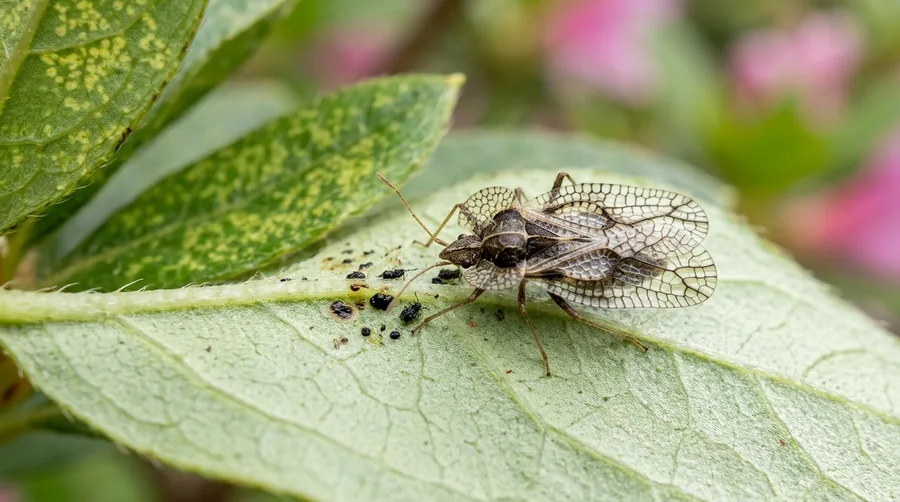
Tiny azalea lace bug with clear lacy wings on the underside of an azalea leaf with stippled upper surface
Recommended Products


What it does
Both adults and nymphs feed on the underside of leaves, piercing the tissue and sucking sap. This removes chlorophyll and produces a coarse, silvery-white stippling on the upper leaf surface that can make an azalea look sun-bleached or drought-stressed. The undersides collect shiny black, tar-like fecal specks and shed skins, a telltale sign.
Where it lives
The azalea lace bug is found wherever azaleas and rhododendrons are grown, and is especially damaging in the Southeast and along the East Coast, as well as in the Pacific Northwest and other regions. Plants in full sun and warm, exposed sites typically suffer heavier infestations than those in shade.
How it breeds
Females insert eggs into leaf tissue along the midrib on the underside, often covering them with a brown varnish-like material. Nymphs pass through several spiny stages before maturing. Multiple generations occur each year, up to four or more in warm regions, allowing populations to build steadily through the growing season.
What it eats
Azalea lace bugs feed on the sap of evergreen and deciduous azaleas and rhododendrons. They are host-specialists and do not move onto unrelated garden plants.
Identification
Adults are small, about 3-4 mm, with flattened, transparent, intricately veined 'lacy' wings held over a brown-black body. Nymphs are smaller, dark, and spiny. The clearest field signs are the silvery stippled upper leaf surface and the dark tar-like spots and cast skins on the leaf underside.
Signs of an infestation
- Coarse silvery-white stippling on the upper leaf surface
- Shiny black, tar-like fecal spots on leaf undersides
- Cast (shed) skins clinging to the underside of leaves
- Tiny lacy-winged adults and spiny dark nymphs beneath leaves
- Overall bleached, drought-stressed look to the shrub
Prevention tips
- Check leaf undersides in spring for early nymphs and the first generation
- Site azaleas in part shade, since sun-stressed plants are hit harder
- Rinse undersides with a strong water spray to dislodge lace bugs
- Keep plants healthy and watered to reduce feeding stress
- Encourage natural predators by avoiding broad-spectrum sprays
Professional solutions
Early treatment of the first generation with insecticidal soap or horticultural oil, applied to leaf undersides, gives the best control for gardeners. Systemic products exist for heavy infestations but should be used carefully near flowering plants. Your Cooperative Extension office can advise on timing and pollinator-safe options if damage is severe.
Health & safety
The azalea lace bug is harmless to people and pets; it does not bite, sting, or carry human disease. Its impact is entirely on plants, where repeated feeding bleaches foliage, dulls the shrub's appearance, and, if severe and recurring, can weaken azaleas and rhododendrons over time.
Relevant Products




Frequently asked questions
Why do my azalea leaves look pale and speckled?
A coarse, silvery-white stippled or bleached look on azalea and rhododendron leaves is typical azalea lace bug damage. Turn the leaves over and look for shiny black tar-like fecal spots, cast skins, and tiny lacy-winged insects feeding on the underside.
When is the best time to treat azalea lace bugs?
Treat early, targeting the first generation of nymphs in spring, with insecticidal soap or horticultural oil applied thoroughly to the leaf undersides where they feed. Because several generations occur each year, catching the first one prevents the heavy midsummer buildup.
Do azalea lace bugs spread to other plants?
No. Azalea lace bugs are host-specialists confined to azaleas and rhododendrons and will not move onto unrelated garden plants. They also do not bite people or pets, so the concern is limited to the appearance and long-term health of the shrubs they feed on.
Fact-checked by Morgan Vance, Editorial Director (editorial review, not a professional pest-control or medical sign-off). Last reviewed May 12, 2026. We correct anything a reader shows us is wrong — see our corrections policy.