Diamondback Moth
Plutella xylostella · also called diamondback moths, cabbage moth, DBM
Quick answer
The diamondback moth (Plutella xylostella) is a small gray-brown moth whose slender green caterpillars chew holes and windowpane patches in cabbage, broccoli, kale, and other cole crops. Named for the diamond pattern along a resting male's back, it breeds rapidly and has grown notoriously resistant to many insecticides worldwide.
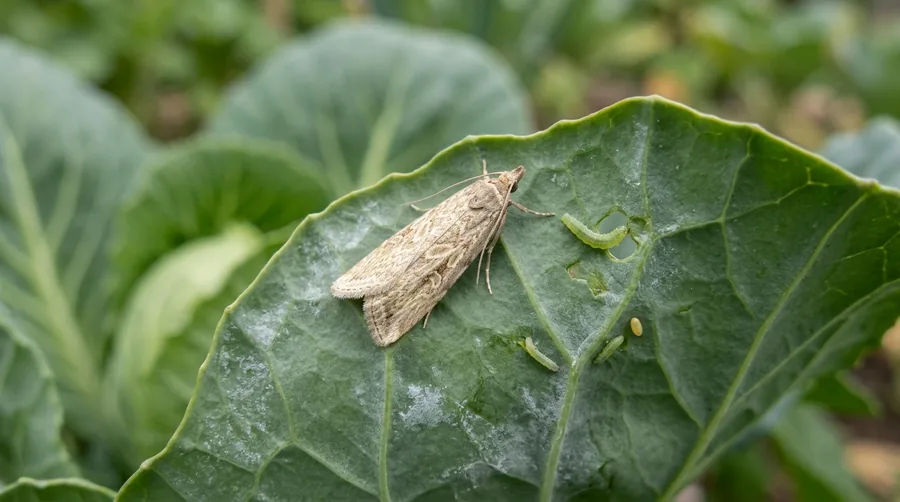
Small gray-brown diamondback moth resting on a green cabbage leaf with pale diamond markings on its back
Recommended Products


What it does
Adult moths are weak fliers active at dusk. The small green larvae feed on the underside of brassica leaves, chewing irregular holes and leaving a thin 'windowpane' layer of leaf tissue. When disturbed, a larva thrashes backward and drops on a silk thread, a behavior that helps it escape predators.
Where it lives
Diamondback moths live wherever cole crops grow, in home gardens and commercial brassica fields. They overwinter in mild southern regions and migrate northward each season on wind currents, so infestations can appear even where the moth cannot survive winter.
How it breeds
Females lay tiny yellowish eggs singly or in small groups on leaves. Larvae pass through four instars in one to two weeks, pupate in a delicate lacy cocoon on the plant, and can complete a generation in about three weeks. Many overlapping generations occur in a single warm season.
What it eats
Larvae feed almost exclusively on plants in the mustard family (Brassicaceae): cabbage, broccoli, cauliflower, kale, collards, canola, and related weeds. Adults sip nectar and do not damage crops.
Identification
Adults are slim gray-brown moths about 8 mm long; when a male folds its wings, three pale marks meet to form a row of light diamonds down the back. Larvae are pale green, tapered at both ends, under 10 mm, and wriggle actively when touched.
Signs of an infestation
- Small irregular holes and 'windowpane' patches on brassica leaves
- Thin green caterpillars feeding on leaf undersides
- Delicate open-mesh cocoons attached to leaves or stems
- Larvae dropping on silk threads when the plant is shaken
- Small gray moths fluttering over the crop at dusk
Prevention tips
- Cover young brassicas with floating row cover to block egg-laying
- Rotate cole crops and remove crucifer weeds that host the moth
- Destroy crop residue promptly after harvest
- Encourage natural enemies such as Diadegma parasitic wasps
- Scout leaf undersides weekly and treat only when thresholds are reached
Professional solutions
Home gardeners usually manage light infestations with row covers, handpicking, and Bacillus thuringiensis (Bt) sprays. Because this moth resists many products, rotate modes of action and follow the label. For repeated crop losses or large plantings, your local Cooperative Extension office can advise on resistance-aware, threshold-based control.
Health & safety
The diamondback moth poses no direct risk to people or pets. It does not bite, sting, or carry human disease, and its caterpillars are harmless to handle. The concern is strictly agricultural: heavy larval feeding can render leafy cole crops unmarketable and stunt young plants.
Relevant Products


Frequently asked questions
What is eating small holes in my cabbage leaves?
Small, scattered holes and thin 'windowpane' patches on cabbage, broccoli, or kale are a classic sign of diamondback moth larvae. Check the leaf undersides for slender pale-green caterpillars under half an inch long that wriggle and drop on a silk thread when you touch the plant.
Are diamondback moth caterpillars harmful to people?
No. Diamondback moth caterpillars do not bite, sting, or carry disease, and they are safe to handle or pick off by hand. They only damage plants in the cabbage family, so the concern is crop loss rather than any health risk.
Why is the diamondback moth so hard to control?
It reproduces very quickly, completing a generation in about three weeks, and populations have developed resistance to many insecticide classes. Rotating chemistries, using Bt, protecting natural enemies, and covering plants early are more reliable than repeated sprays of a single product.
Fact-checked by Morgan Vance, Editorial Director (editorial review, not a professional pest-control or medical sign-off). Last reviewed July 10, 2026. We correct anything a reader shows us is wrong — see our corrections policy.