
Cabbage Looper
Trichoplusia ni · also called cabbage loopers
Quick answer
The cabbage looper (Trichoplusia ni) is a smooth green caterpillar that arches its body into a loop as it crawls. It chews ragged holes in cabbage, lettuce, and many other crops, feeding on leaves and contaminating heads. The larva of a gray moth, it does not bite or sting people and is purely a plant pest.
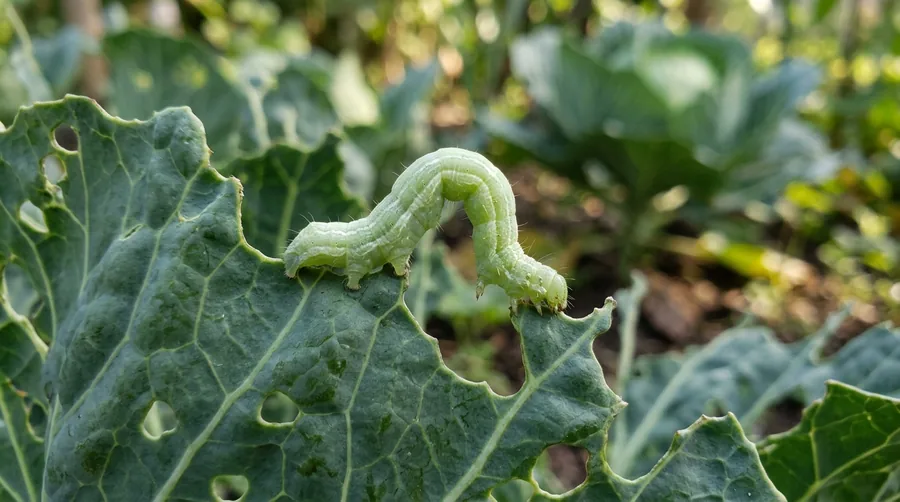
Green cabbage looper caterpillar arching its body in a loop on a cabbage leaf
Recommended Products


What it does
Cabbage loopers chew large, irregular holes in leaves, working from the underside and moving into the center of the plant as they grow. Their looping crawl (they lack the middle prolegs of other caterpillars) is a giveaway. Besides eating foliage, their droppings contaminate the heads of cabbage and other cole crops.
Where it lives
A wide-ranging pest, it feeds on cabbage-family crops plus lettuce, spinach, tomato, celery, and many others, in gardens and fields nationwide. It cannot survive cold winters in the North and recolonizes northern crops each year as moths move up from the South, where it can be active most of the year.
How it breeds
A female moth lays round, pale eggs singly on leaf undersides. Larvae feed for two to four weeks through several stages, then spin a thin cocoon attached to a leaf to pupate. Several generations occur each season, with populations building into late summer and fall.
What it eats
Cabbage loopers eat a wide range of plants, especially cabbage-family crops (cabbage, broccoli, cauliflower, kale) plus lettuce, spinach, celery, tomato, and others.
Identification
Mature larvae are about 1.5 inches, smooth and pale green, tapering toward the head, with a few thin white lines running down the back. The looping movement distinguishes them from other cabbage caterpillars. The adult is a mottled gray-brown moth with a small silvery mark on each forewing.
Signs of an infestation
- Large ragged holes chewed in leaves
- Green or dark droppings scattered on and inside heads
- Smooth green caterpillars that loop when they crawl
- Thin cocoons attached to leaf undersides
- Skeletonized patches on cole-crop leaves
Prevention tips
- Check leaf undersides regularly and hand-pick caterpillars
- Use floating row covers to keep moths off young crops
- Encourage parasitic wasps, lacewings, and other natural enemies
- Remove crop debris and cole-crop weeds after harvest
- Rotate cole crops to reduce local buildup
Professional solutions
Home gardeners can manage cabbage loopers by hand-picking and with a Bt (Bacillus thuringiensis) product that targets caterpillars while sparing beneficial insects. For field crops, a local extension agent or agronomist can advise on scouting thresholds and labeled products, since loopers can develop resistance to some insecticides.
Health & safety
Cabbage loopers do not bite, sting, or carry any disease that affects people or pets, so they are harmless to handle. The damage is limited to plants: chewed leaves and droppings that reduce yield and contaminate the harvested heads of cabbage and leafy greens.
Relevant Products


Frequently asked questions
How is a cabbage looper different from a cabbageworm?
The looper is smooth, pale green with thin white lines, and arches into a loop as it crawls. The imported cabbageworm is velvety and fuzzy and crawls without looping. Both chew holes in cole crops and respond to hand-picking and Bt.
What is the safest way to control cabbage loopers?
Hand-pick caterpillars from leaf undersides and use a Bt (Bacillus thuringiensis) product, which kills caterpillars but spares bees, ladybugs, and other beneficial insects. Row covers on young plants also keep egg-laying moths away.
Fact-checked by Morgan Vance, Editorial Director (editorial review, not a professional pest-control or medical sign-off). Last reviewed June 27, 2026. We correct anything a reader shows us is wrong — see our corrections policy.