Carpenter Ant
Camponotus spp. · also called carpenter ants, black carpenter ant, wood ant
Quick answer
Carpenter ants (Camponotus species) are among the largest US ants, usually black or red and black. They don't eat wood like termites but tunnel through damp, decaying wood to nest, leaving piles of sawdust-like frass. Over years they can weaken structural wood, and they forage indoors for sweets and protein.
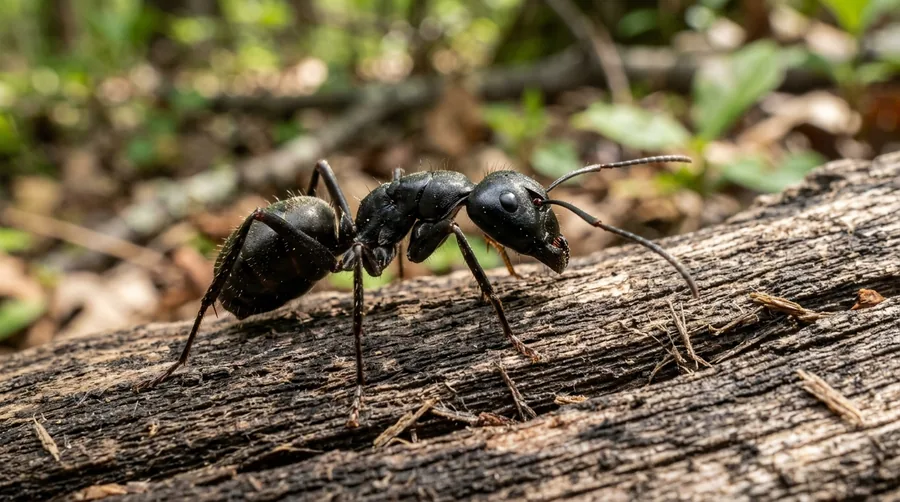
Large black carpenter ant on damp wood beside a small pile of sawdust-like frass
Recommended Products
See the full ranking →

What it does
Carpenter ants are mostly nocturnal foragers that follow trails and excavate smooth galleries in moist or damaged wood to nest, rather than eating the wood. They can bite and spray formic acid. A parent colony outdoors often sends workers to satellite nests inside the home.
Where it lives
Outdoors they nest in dead trees, stumps, logs, and firewood. Indoors they favor moisture-damaged wood around leaky windows, roofs, chimneys, bathrooms, and dishwashers, and in wall voids and insulation. They are especially common in the Northeast and Pacific Northwest, but occur nationwide.
How it breeds
A colony has a queen and workers of varying sizes and matures over roughly three to six years. Winged reproductives swarm in spring to start new colonies. Satellite nests inside structures hold nymphs and pupae moved from the parent colony.
What it eats
Carpenter ants forage for sweets such as honeydew and sugars, plus proteins and other insects. Indoors they eat food spills, grease, and sweets. Importantly, they do not eat wood; they only tunnel through it to nest.
Identification
Workers are large (up to about 1/2 inch), with a single waist node, an evenly rounded thorax profile, and bent (elbowed) antennae. Swarmers have a pinched waist and unequal-length wings, which separates them from termite swarmers, whose waist is straight and wings equal.
Signs of an infestation
- Coarse sawdust-like frass containing insect parts below wood
- Faint rustling sounds inside walls at night
- Large ants indoors, especially after dark
- Winged ants emerging at windows in spring
- Smooth, clean galleries in moisture-damaged wood
Prevention tips
- Fix roof and plumbing leaks and reduce indoor moisture
- Replace water-damaged or decayed wood
- Keep firewood, mulch, and lumber away from the foundation
- Trim tree branches touching the roof or siding
- Seal gaps around utility lines, windows, and doors
Professional solutions
Locating the nest is the key to control, since surface sprays miss it. Professionals use targeted baits and treatments and correct the moisture that attracted the ants. Large, hidden, or structural nests are best handled by a pro. Always read and follow the EPA label on any product.
Health & safety
Carpenter ants can bite and spray formic acid, producing a brief stinging sensation, but they are not venomous in a medical sense and spread no known disease. The main concern is structural: over time their galleries can weaken wood, making household risk moderate.
Relevant Products


Frequently asked questions
Do carpenter ants eat wood like termites?
No. Carpenter ants tunnel through damp or damaged wood to build nests but do not eat it, so they push out sawdust-like frass. Termites actually consume wood. This is why carpenter ant damage is usually slower and tied to moisture problems.
How do I know if I have carpenter ants or termites?
Look at the frass and the swarmers. Carpenter ants leave coarse sawdust with insect parts and have a pinched waist with unequal wings, while termites leave no sawdust and have a straight waist with equal wings. A professional can confirm which one you have.
Where are carpenter ants nesting in my house?
They favor moisture-damaged wood around leaky roofs, windows, bathrooms, and dishwashers, and inside wall voids and insulation. Following trails at night and finding frass helps locate the nest; fixing the underlying moisture is an important part of control.
Fact-checked by Morgan Vance, Editorial Director (editorial review, not a professional pest-control or medical sign-off). Last reviewed May 31, 2026. We correct anything a reader shows us is wrong — see our corrections policy.