Boll Weevil
Anthonomus grandis · also called boll weevils, cotton boll weevil
Quick answer
The boll weevil (Anthonomus grandis) is a small gray-brown weevil with a long snout that attacks cotton, feeding on and laying eggs in the flower buds and bolls. It once devastated the US cotton belt, but a long-running eradication program has cleared it from nearly all American cotton. It is harmless to people.
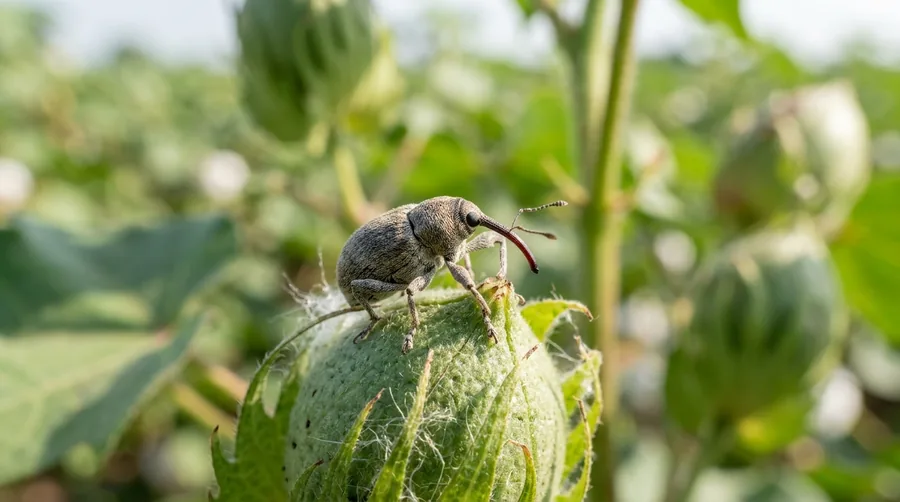
Small gray-brown boll weevil with a long curved snout on a cotton boll
Recommended Products


What it does
Adult boll weevils use their long snouts to puncture cotton flower buds (squares) and bolls, feeding on them and laying eggs inside. The grubs develop within, destroying the bud or boll. Because the pest hides and breeds inside the cotton structures, damage builds quickly and historically could ruin much of a crop.
Where it lives
A pest specific to cotton, it lives in cotton fields across the historic southern US cotton belt. Adults overwinter in leaf litter, field margins, and woods near fields, then move into cotton as it grows in summer. Thanks to eradication efforts, active populations now persist only in limited areas near the Texas-Mexico border.
How it breeds
Overwintered adults enter cotton fields in early season and lay eggs inside squares and bolls. Each egg hatches into a grub that feeds, pupates, and emerges as a new adult within the structure in as little as two to three weeks, so multiple overlapping generations can build through a single growing season.
What it eats
Boll weevils feed almost exclusively on cotton, attacking the flower buds (squares) and developing bolls.
Identification
Adults are about 1/4 inch, grayish to reddish-brown and fuzzy, with a long, down-curved snout roughly half the body length, tipped with tiny jaws. Small dark feeding and egg-laying punctures in cotton squares, and squares that yellow and drop, are typical field signs.
Signs of an infestation
- Punctures in cotton flower buds (squares) and bolls
- Yellowed squares that flare and drop from the plant
- Grubs developing inside damaged squares or bolls
- Adult weevils with long snouts on cotton plants
- Captures in pheromone monitoring traps at field edges
Prevention tips
- Report suspected finds to the regional boll weevil eradication program
- Support areawide pheromone trapping and monitoring
- Destroy cotton stalks promptly after harvest
- Follow program guidance on planting and treatment windows
- Manage overwintering habitat around fields
Professional solutions
Boll weevil control is handled through a coordinated, regionwide eradication program rather than by individual action, so any suspected sighting should go to the local cooperative or extension office. Officials use pheromone traps and targeted, program-directed insecticide applications; this areawide approach is what cleared the weevil from most US cotton.
Health & safety
Boll weevils do not bite, sting, or carry any disease affecting people or pets, so they pose no health risk. Their significance is agricultural and historical: they caused immense damage to US cotton for decades, a legacy now largely undone by the eradication program except in a few border areas.
Relevant Products


Frequently asked questions
Is the boll weevil still a problem in the US?
Mostly no. A decades-long, coordinated eradication program has removed the boll weevil from nearly all US cotton-growing regions. Monitoring continues, and small remnant populations persist mainly near the Texas-Mexico border, where trapping and control are ongoing.
What does a boll weevil do to cotton?
Adults puncture cotton flower buds and bolls to feed and lay eggs inside, and the grubs develop within, destroying the bud or boll. Damaged squares yellow and drop, and heavy infestations historically could devastate a cotton crop.
Fact-checked by Morgan Vance, Editorial Director (editorial review, not a professional pest-control or medical sign-off). Last reviewed June 16, 2026. We correct anything a reader shows us is wrong — see our corrections policy.