
Black Soldier Fly
Hermetia illucens · also called black soldier flies, BSF, soldier fly
Quick answer
The black soldier fly (Hermetia illucens) is a large, harmless black fly whose larvae are prized decomposers in compost and animal feed. Adults have no working mouthparts, so they never bite or feed, and they spread no disease. Wasp-like in looks only, it is a beneficial insect, not a pest to fear.
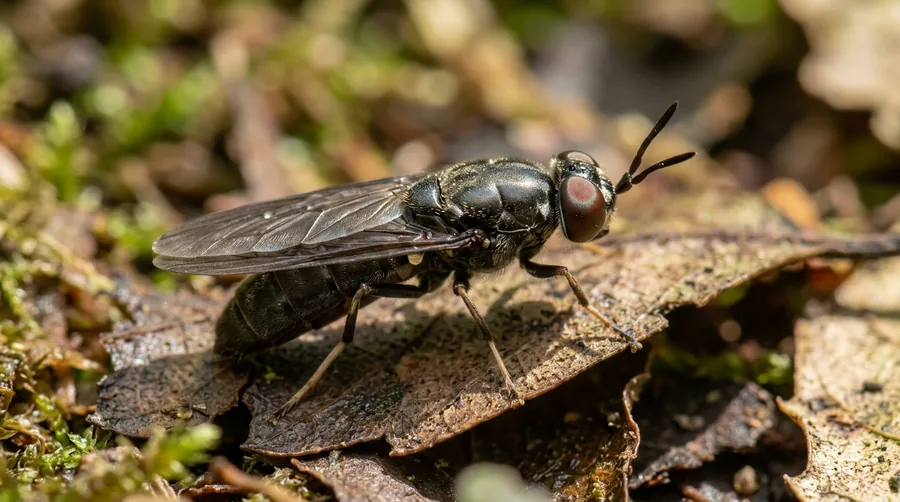
Slender black black-soldier-fly with translucent wings resting on a green leaf
Recommended Products


What it does
Adult black soldier flies are slow, docile, and non-feeding; they spend their short adult lives mating and laying eggs, and they do not swarm food or people. The larvae are voracious decomposers that rapidly break down manure, food scraps, and decaying plant matter, which is why they are raised commercially for composting and animal feed.
Where it lives
Larvae develop in rich, moist decaying organic matter: compost bins, manure, food waste, and occasionally overloaded green bins or drains. Adults rest on nearby vegetation and walls. The species is common across warm regions of the US and increasingly widespread, especially in the South and around composting and livestock areas.
How it breeds
Females lay clusters of eggs near, not in, decaying material. Larvae hatch and feed intensively for a couple of weeks to a month, then crawl away to a dry spot to pupate. The whole cycle takes several weeks in warm conditions. Adults live only about a week and do not eat.
What it eats
Larvae eat decaying organic matter, manure, and food waste and are exceptionally efficient at it. Adults do not feed at all, having reduced, non-functional mouthparts, so they take neither food nor blood.
Identification
Adults are slender, wasp-like black flies about 15-20 mm, with smoky wings and two translucent 'window' spots near the base of the abdomen. Larvae are flattened, grayish-brown, tough-skinned grubs up to about 27 mm. Their large size and calm behavior distinguish them from house flies and wasps.
Signs of an infestation
- Large, slow black flies around a compost bin or green waste
- Fat grayish larvae working through compost or food scraps
- Larvae crawling away from moist waste to pupate
- Adults resting calmly on walls and plants
- No biting, swarming, or landing on prepared food
Prevention tips
- Keep compost balanced with enough dry 'brown' material
- Use a well-sealed compost or green-waste bin
- Bury food scraps and avoid excess meat and dairy in compost
- Empty and clean green bins regularly in warm weather
- Screen or cover organic waste to limit egg-laying
Professional solutions
Black soldier flies almost never require pest control, and many gardeners actively welcome the larvae for composting. If large numbers become a nuisance around bins, adjusting compost management, moisture, and cover resolves it. There is no need for insecticide; managing the organic-matter source is the appropriate and effective response.
Health & safety
Black soldier flies are essentially harmless to people and pets. Adults cannot bite or sting and do not feed, and unlike house flies they are not known to spread disease because they do not land on food and filth in the same way. They are widely regarded as beneficial decomposers rather than a health concern.
Relevant Products


Frequently asked questions
Is the black soldier fly dangerous or does it bite?
No. Adult black soldier flies have no functional mouthparts, so they cannot bite, sting, or feed, and they are not known to spread disease. Despite a wasp-like look, they are docile and are considered beneficial insects, valued for composting and as animal feed.
Should I kill black soldier fly larvae in my compost?
Usually not. The larvae are excellent, harmless decomposers that speed up composting, and many gardeners welcome them. If numbers become a nuisance, adjust the compost with more dry material, better cover, and less meat and dairy rather than using insecticide.
Fact-checked by Morgan Vance, Editorial Director (editorial review, not a professional pest-control or medical sign-off). Last reviewed June 28, 2026. We correct anything a reader shows us is wrong — see our corrections policy.