
Big Brown Bat
Eptesicus fuscus · also called big brown bat, house bat
Quick answer
The big brown bat (Eptesicus fuscus) is one of the most widespread US bats, a sturdy brown insect-eater larger than the little brown bat. Tolerant of cold, it commonly roosts and even overwinters in attics, barns, and wall voids. It poses a rabies risk, guano can carry a lung fungus, and it is legally protected.
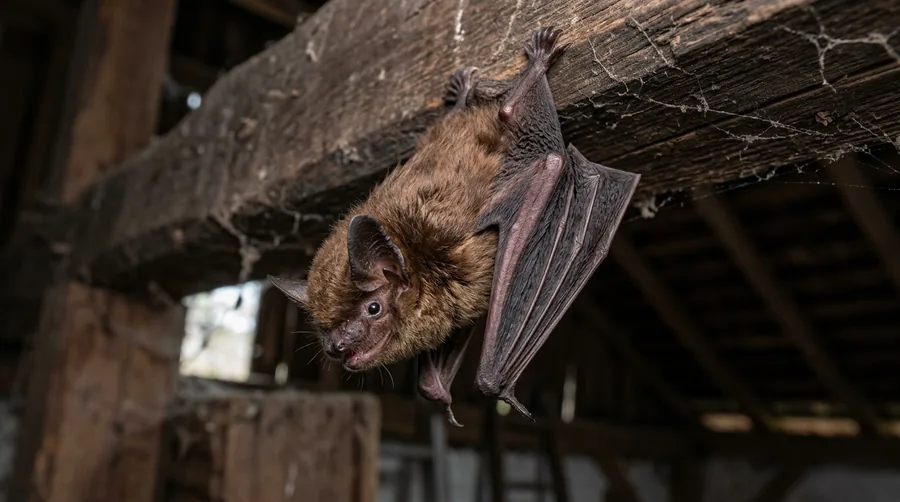
Big brown bat with broad wings clinging to a rafter inside an attic
Recommended Products



What it does
Big brown bats are nocturnal, emerging at dusk to catch beetles and other flying insects by echolocation. They roost in colonies by day, and females form maternity groups to raise young in warm attics and barns. Hardier than most bats, they sometimes remain in heated buildings through winter rather than migrating to caves.
Where it lives
Found nationwide, big brown bats readily use human structures, roosting in attics, barns, wall voids, behind siding and shutters, and in soffits. They also use tree cavities and rock crevices. Their cold tolerance means a building colony can persist longer into the season than other species'.
How it breeds
Big brown bats mate in fall and store sperm over winter. Females raise young in maternity colonies, producing one or two pups per year depending on region, born in early summer and flying within weeks. Like other bats, their low reproductive rate means slow population recovery.
What it eats
Big brown bats are insectivores with a strong preference for beetles, including some crop and garden pests, along with moths, flies, and other flying insects. They are efficient nighttime insect controllers when roosting away from occupied living space.
Identification
Look for a robust bat 4-5 inches long with a 13-16 inch wingspan, uniform chocolate-brown fur, a broad nose, and black wings and ears. It is noticeably larger than the little brown bat; a wildlife professional can confirm the species and the roost location.
Signs of an infestation
- Piles of dark droppings under a wall or roof gap
- Greasy brown staining around an entry point
- Bats emerging at dusk from the eaves or roofline
- Scratching, squeaking, or rustling in walls and attic
- An ammonia-like odor from guano accumulation
Prevention tips
- Seal roofline, soffit, and siding gaps outside maternity season
- Screen attic vents, louvers, and chimney openings
- Repair loose flashing, shutters, and fascia
- Reduce bright lights near common entry points
- Use professional one-way exclusion devices when bats are present
Professional solutions
As with all bats, a big brown bat colony in a building should be removed by a licensed wildlife professional through humane exclusion, one-way devices plus sealing, never trapping or poisoning. Exclusion is prohibited during the summer maternity season (roughly June to mid-August) so pups are not sealed in. Pros also decontaminate guano safely.
Health & safety
A small percentage of bats carry rabies, and bites can be tiny and easy to miss, so any contact, or a bat in a room with a sleeper, child, or pet, should be reported to your health department and a doctor. Guano can harbor Histoplasma fungus, a lung-infection risk if disturbed, so leave cleanup to professionals. Bats are legally protected. Risk is moderate.
Relevant Products




Frequently asked questions
What is the difference between a big brown bat and a little brown bat?
The big brown bat is noticeably larger, about 4-5 inches long with a 13-16 inch wingspan, and it tolerates cold well enough to sometimes overwinter inside heated buildings. The little brown bat is smaller and usually migrates to caves. Both are protected and require humane exclusion rather than extermination.
Can I remove big brown bats myself?
Because bats are legally protected and can carry rabies, removal is best left to a licensed wildlife professional using one-way exclusion devices and sealing, done outside the summer maternity season. Never trap, poison, or seal bats inside, both because it is often illegal and because it creates serious odor and health problems.
How do I know if bats are in my walls?
Common clues are piles of dark droppings and greasy stains beneath a roofline or wall gap, bats seen leaving at dusk, scratching or squeaking sounds inside walls and the attic, and an ammonia-like guano odor. A wildlife professional can inspect, confirm the species, and locate the entry points.
Fact-checked by Morgan Vance, Editorial Director (editorial review, not a professional pest-control or medical sign-off). Last reviewed August 10, 2026. We correct anything a reader shows us is wrong — see our corrections policy.