


Boric acid is one of the oldest and cheapest roach-control tools still in wide use — and it works, if you apply it correctly. Most boric acid failures come down to using too much, putting it in the wrong places, or letting it get wet. Understanding how it kills makes the right technique obvious.
How Boric Acid Kills Roaches
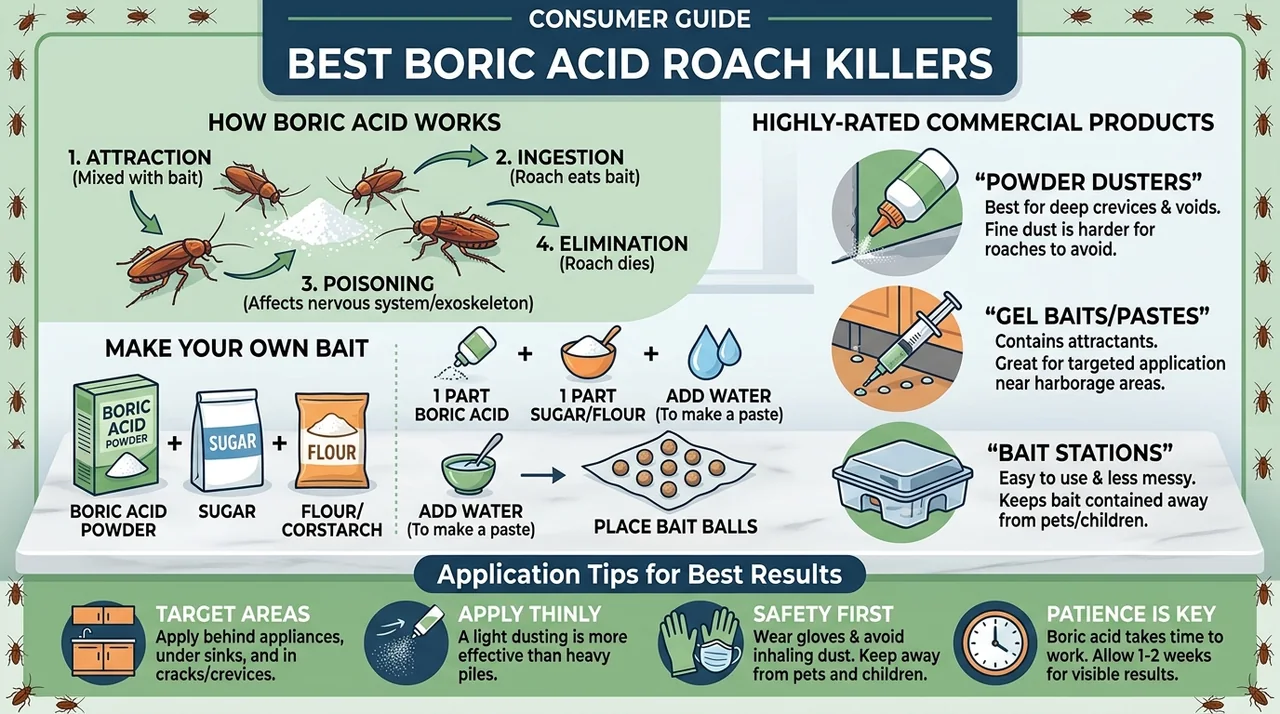
Boric acid acts as both a slow stomach poison and an abrasive contact agent. Roaches walk through the fine powder, it clings to their legs and body, and they swallow it while grooming themselves clean. Once ingested it disrupts their digestive and nervous systems, killing over several days. That slowness is a feature, not a flaw: roaches have time to return to their harborage, where cannibalism and the consumption of contaminated droppings can spread the effect to roaches you never treated directly.
Crucially, it only works dry. A damp or clumped layer loses its cling, and roaches actively avoid thick, visible piles.
Applying the Powder Correctly
The golden rule is less is more: a barely visible film, not a white drift. Roaches walk around obvious powder but stroll straight through a thin dusting. Use a bulb duster to puff a light layer into the places roaches actually travel and hide:
- Cracks and crevices, behind and under the refrigerator and stove
- The void under and behind the sink cabinet
- Along wall voids via outlet plates (only with the power off)
- Under and behind appliances, and along baseboards
Boric Acid vs. Borate Gels and Bait Tablets
If loose dust isn't for you, ready-made boric acid gel baits and tablets pair the active with an attractant. They're more palatable, more targeted, and far less messy than raw powder — a good fit for homes where a visible dusting isn't practical. Compared with modern gel actives like fipronil or indoxacarb, boric acid is cheaper, has little known resistance problem, and is dependable, but it's slower and less attractive on its own, which is exactly why the attractant-carrying bait forms exist. A common, effective combination is boric acid dust deep in dry voids plus a modern gel bait along active runways.
Pairing Boric Acid With Sanitation
Boric acid controls roaches far faster when you remove their competing food and water. Roaches that can graze on crumbs, grease films, pet food left out overnight, and dripping faucets have less reason to travel across your treated cracks. Clean under and behind appliances, store food and pet food in sealed containers, take out trash regularly, and fix plumbing leaks and condensation. Reducing clutter such as stacked cardboard and paper bags also removes the tight, dark harborage German cockroaches favor. With their easy resources gone, roaches range more widely, contact the powder sooner, and the colony declines faster than treatment alone would achieve.
Boric acid has relatively low acute toxicity for people, but it is not harmless — keep it out of reach, never apply it where kids or pets make contact, and never dust it on surfaces where food is prepared. Follow the EPA-registered label, and for any ingestion call Poison Control at 1-800-222-1222.


