
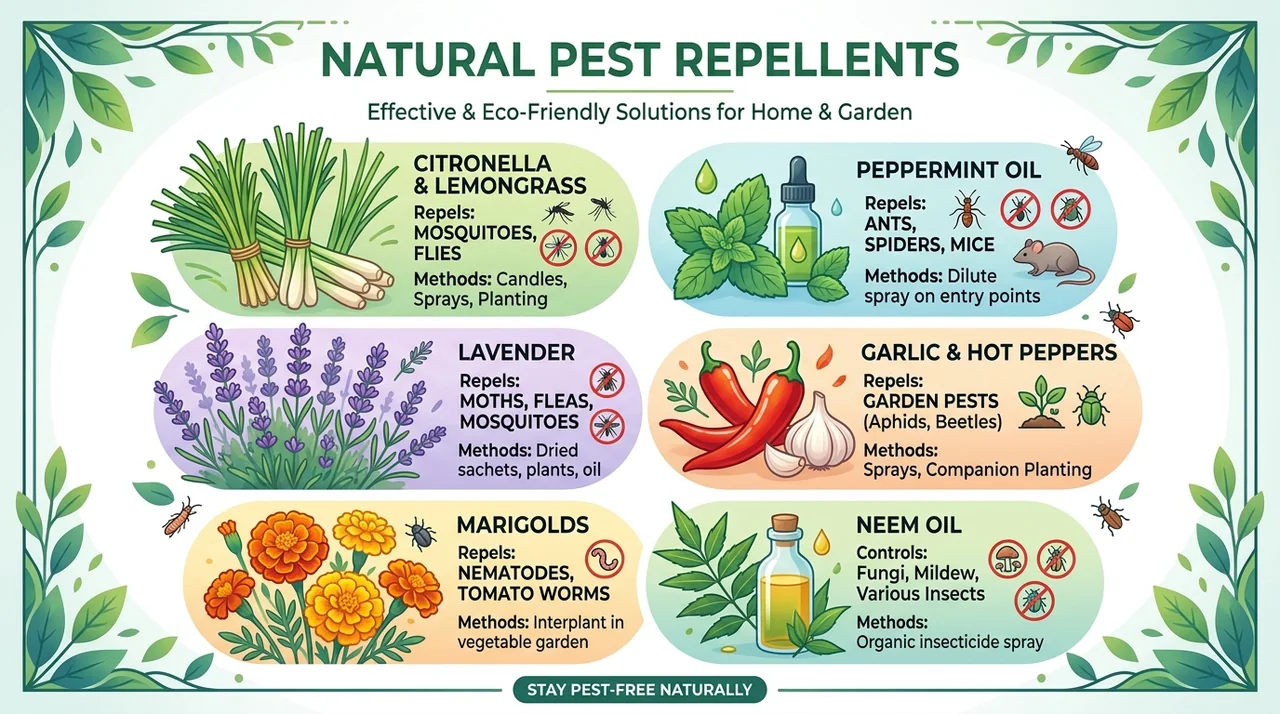


Natural pest repellents, peppermint oil sprays, citronella, cedar, vinegar, and similar remedies, are hugely popular, and it is fair to ask whether they actually work. The honest answer is nuanced: some have measurable but modest and short-lived effects, others are mostly folklore, and none reliably substitutes for prevention. This guide separates the two so you can use natural repellents where they genuinely help, alongside the natural-products companion in this section.
What the Evidence Supports
A handful of natural actives have real, documented repellent activity, though usually weaker and shorter-lasting than conventional options:
- Oil of lemon eucalyptus (OLE) / PMD stands out because it is EPA-registered as an effective mosquito repellent and recommended by public-health authorities, alongside DEET and picaridin. It is the clearest example of a plant-derived repellent that works, when applied per its label (not for children under three).
- Essential oils such as peppermint, cedar, lemongrass/citronella, and thyme can repel or irritate some insects on contact, and lab studies show activity for several. In practice, though, their effect fades quickly as the oils evaporate, so any repellency is short and requires frequent reapplication.
- Citronella candles may modestly reduce mosquito landings in the immediate area but are easily overwhelmed by wind and do not protect exposed skin well.
Where Claims Outrun the Evidence
Many popular "natural repellent" ideas have little reliable support:
- Ultrasonic and app-based repellents are not backed by evidence and generally do not work (covered separately in this site's repeller section).
- Repellent plants (citronella grass, marigolds, mint) growing in the garden do not release enough active compound to protect a yard, despite the popular belief.
- Vinegar, essential-oil "barrier sprays," and DIY foliage sprays may repel briefly on contact but rarely provide the durable protection people expect, and results are inconsistent.
Set Realistic Expectations and Use Them Well
Natural repellents can play a role if you understand their limits: expect modest, short-lived effects that need frequent reapplication, and do not rely on them alone where mosquito-borne disease is a concern, choose an EPA-registered repellent (OLE, DEET, or picaridin) for genuine protection there. For general nuisance pests, natural repellents are best combined with the real drivers of control: eliminating standing water, sealing entry points, storing food properly, and cleaning up attractants.
"Natural" is also not a synonym for "safe." Some essential oils are toxic to cats and dogs, and concentrated oils can irritate skin. A useful way to think about it: a repellent's job is only to reduce contact, not to eliminate a pest population, so even a repellent that works simply keeps insects at bay for a while rather than solving an infestation. That is why prevention, not repelling, remains the foundation. Read and follow any product label, keep products away from pets and children, and verify pet safety with a reliable source or your veterinarian before use. If anyone ingests a product or reacts to it, call Poison Control at 1-800-222-1222, or contact a veterinarian or the ASPCA Animal Poison Control Center for a pet.


