
Smaller European Elm Bark Beetle
Scolytus multistriatus · also called elm bark beetle, European elm bark beetle
Quick answer
The smaller European elm bark beetle (Scolytus multistriatus) is a small reddish-brown beetle that bores under elm bark to breed. Its real danger is indirect: it carries the fungus that causes Dutch elm disease, spreading a plague that has killed millions of American elms. It threatens trees, not people or homes directly.
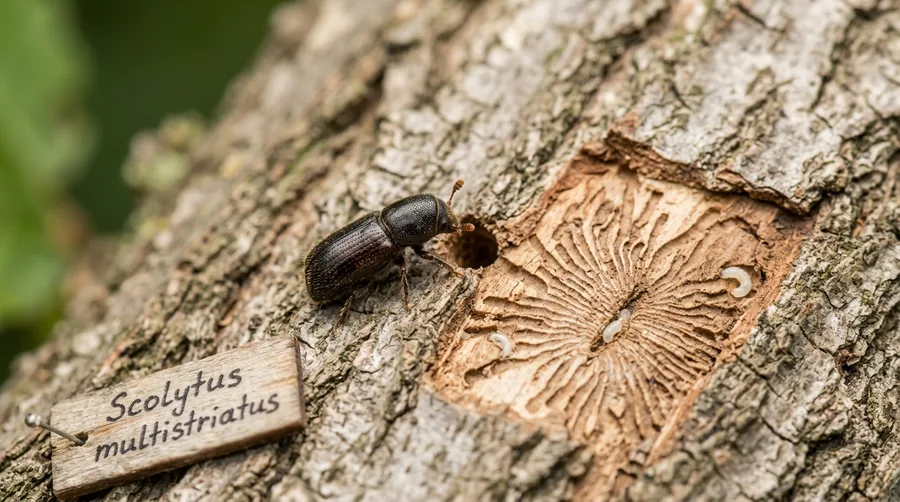
Small reddish-brown elm bark beetle beside branching galleries etched under elm bark
Recommended Products


What it does
Adults tunnel through elm bark to feed at twig crotches and to excavate egg galleries in the inner bark of weak or dying elms. As they feed, beetles carrying spores of the Dutch elm disease fungus introduce it into healthy trees. The larvae then bore side tunnels, creating a distinctive branching gallery pattern.
Where it lives
It lives on American and European elms across most of the US wherever elms grow. Beetles breed in dying, stressed, or recently cut elm wood and firewood, then fly to feed in the canopies of healthy elms, which is how the disease moves through a neighborhood.
How it breeds
There are usually two generations a year in much of the US. Females lay eggs along a central gallery under the bark; larvae feed outward, pupate, and emerge as adults through small round 'shot-hole' exit holes. Beetles overwinter as larvae in the bark.
What it eats
Adults feed on the tender bark of twig crotches on healthy elms, which is the moment disease transmission occurs. Larvae feed on the inner bark (phloem) of dying or dead elm wood.
Identification
Adults are small, stout, reddish-brown to dark brown beetles about 2-3 mm long, hard to spot without looking. More visible are the round shot-hole exit holes in bark and the centipede-like branching galleries etched into the inner bark and sapwood of infested elms.
Signs of an infestation
- Small round shot-hole exit holes in elm bark
- Branching, centipede-like galleries under peeled bark
- Yellowing, wilting 'flagging' branches on elms
- Brown streaking in the sapwood of cut branches
- Rapid crown dieback of a previously healthy elm
Prevention tips
- Promptly remove and destroy dead or dying elm wood and stumps
- Never store elm firewood with bark still attached
- Keep elms vigorous with proper watering and pruning of deadwood
- Prune elms in the dormant season, not during beetle flight
- Report suspected Dutch elm disease to a certified arborist quickly
Professional solutions
Protecting valuable elms is a job for a certified arborist. Programs combine sanitation (removing beetle breeding wood), preventive fungicide injections for high-value trees, and community-level monitoring. Once Dutch elm disease is established in a tree, removal is often required to protect nearby elms. Any pesticide use follows the EPA-registered label.
Health & safety
This beetle does not bite, sting, or carry any human disease, so there is no direct health risk to people or pets. The 'disease' it spreads is Dutch elm disease, a fungal plant pathogen that kills elm trees. The impact is to landscape trees and property value, not to human health.
Relevant Products




Frequently asked questions
Does the elm bark beetle bite or make people sick?
No. The smaller European elm bark beetle does not bite, sting, or transmit any human disease. The disease it spreads, Dutch elm disease, is a fungus that kills elm trees, so the risk is entirely to trees and property, not to your health.
How does the beetle spread Dutch elm disease?
Beetles breeding in diseased elm wood pick up fungal spores, then fly to healthy elms to feed at twig crotches, introducing the fungus into the tree's vascular system. Removing dead elm wood where beetles breed is the most important way to slow the spread.
Fact-checked by Morgan Vance, Editorial Director (editorial review, not a professional pest-control or medical sign-off). Last reviewed July 12, 2026. We correct anything a reader shows us is wrong — see our corrections policy.