
Peachtree Borer
Synanthedon exitiosa · also called peach tree borer, greater peachtree borer
Quick answer
The peachtree borer (Synanthedon exitiosa) is a clearwing moth whose larvae bore into the lower trunk, crown, and roots of peach, cherry, plum, and other stone-fruit trees. Their tunneling can girdle and kill young trees. The wasp-like adult moth is harmless, but gummy sap mixed with frass at the tree base signals an active infestation.
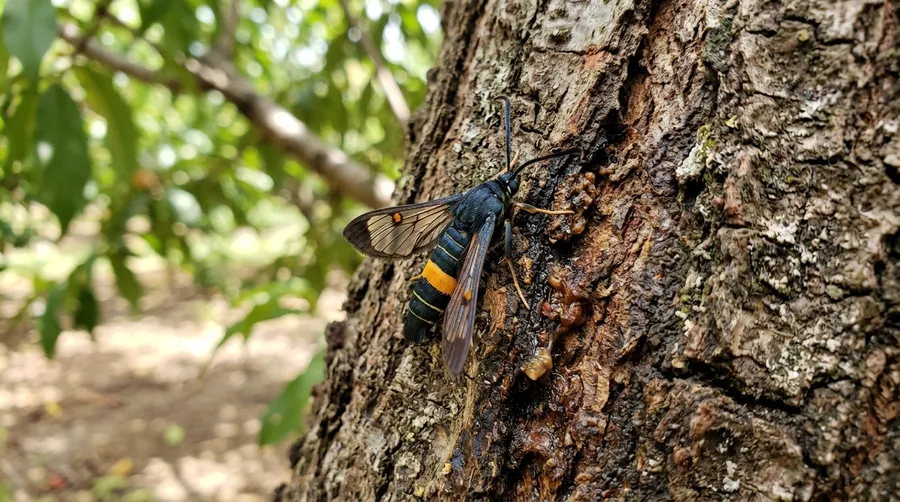
Metallic blue-black peachtree borer clearwing moth resembling a wasp with an orange-banded abdomen
Recommended Products


What it does
The damage is done by the larvae, which bore into the trunk near and just below the soil line and feed on the inner bark and cambium of the lower trunk, crown, and large roots. This tunneling can girdle the tree, cutting off its flow of nutrients. Young and newly planted stone-fruit trees are especially vulnerable and can be killed, while older trees are weakened and made prone to other problems.
Where it lives
Peachtree borer attacks stone fruits in the genus Prunus, including peach, nectarine, cherry, plum, apricot, and ornamental cherries and plums. It is found in home orchards, commercial orchards, and landscapes across the United States. The larvae live at the base of the trunk and in the crown and upper roots, right around the soil line.
How it breeds
There is one generation per year. Adults, which are day-flying clearwing moths, emerge in summer and lay eggs on or near the lower trunk. Larvae hatch, bore into the bark near the soil line, and feed through fall and winter, overwintering under the bark. They resume feeding in spring, pupate near the soil surface, and emerge as moths, continuing the cycle.
What it eats
The larvae feed on the inner bark, cambium, and sapwood of the lower trunk, crown, and roots of Prunus trees. The adult moths take nectar but do no damage. The insect depends on living stone-fruit trees to complete its development.
Identification
The adult is a striking clearwing moth, about a one-inch wingspan, with a metallic steel-blue to blue-black body that mimics a wasp; females have a broad orange band on the abdomen, males are more slender with narrow yellow bands. The clearest sign, though, is at the base of the tree: masses of gummy sap (gum) mixed with sawdust-like frass oozing from the lower trunk near the soil.
Signs of an infestation
- Masses of gummy sap mixed with frass at the base of the trunk
- Sawdust-like frass in the soil around the trunk
- Wet, oozing, or discolored bark near the soil line
- Wilting, yellowing, or sparse foliage on young trees
- Loose or dying bark around the crown
- Wasp-like clearwing moths flying around trees in summer
Prevention tips
- Keep trees vigorous with proper watering, mulching, and fertility
- Avoid wounding the lower trunk with mowers and string trimmers
- Inspect the trunk base each summer and fall for gum and frass
- Remove weeds and keep the trunk base exposed for easy monitoring
- Use pheromone traps to time any control and monitor adult flights
Professional solutions
For home orchards, monitoring and careful trunk inspection are the first line of defense; some growers 'worm' larvae out of the bark by hand. Properly timed trunk sprays around adult flight can protect trees, and pheromone mating disruption is used in larger orchards. A certified arborist or extension office can advise on products and timing, since success depends heavily on treating when eggs and young larvae are present.
Health & safety
The peachtree borer poses no risk to people or pets; the wasp-like adult is a harmless moth that does not sting, and the insect spreads no disease. The concern is entirely to tree health and property, as larval girdling can kill young stone-fruit trees and reduce yields, making it a significant orchard and landscape pest.
Relevant Products


Frequently asked questions
What is the gummy sap at the base of my peach tree?
Gobs of sticky sap mixed with sawdust-like frass at the base of a peach, cherry, or plum trunk are a classic sign of peachtree borer larvae feeding under the bark near the soil line. Trees produce this gum in response to the tunneling. Inspect the trunk base and consider properly timed control.
Is the wasp-like insect around my fruit tree dangerous?
No. The adult peachtree borer is a clearwing moth that mimics a wasp for protection but cannot sting and does not harm people or pets. The real damage comes from its larvae boring into the lower trunk and roots, so the moth is mainly a signal that egg-laying is underway.
How do I protect young fruit trees from peachtree borer?
Keep trees healthy, avoid trunk wounds from mowers and trimmers, and inspect the trunk base for gum and frass in summer and fall. Pheromone traps help time control, and properly timed trunk sprays or, in larger orchards, mating disruption protect trees. An extension office can advise on timing and products.
Fact-checked by Morgan Vance, Editorial Director (editorial review, not a professional pest-control or medical sign-off). Last reviewed July 22, 2026. We correct anything a reader shows us is wrong — see our corrections policy.