
Dogwood Borer
Synanthedon scitula · also called dogwood borer moth
Quick answer
The dogwood borer (Synanthedon scitula) is a clearwing moth whose larvae tunnel beneath the bark of flowering dogwood and other trees, usually entering through wounds. Their feeding girdles limbs and trunks, causing dieback, sloughing bark, and decline, and it can kill stressed or young trees. The wasp-like adult moth is harmless; sawdust-like frass signals larvae.
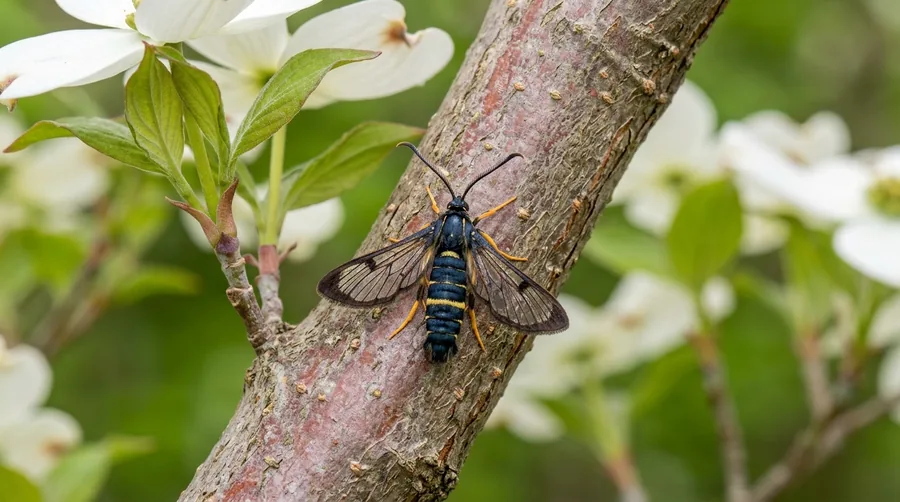
Black clearwing dogwood borer moth with yellow markings resembling a wasp on dogwood bark
Recommended Products


What it does
Larvae are the damaging stage. They bore into the bark, usually through existing wounds, cracks, or sunscald, and feed in the inner bark and cambium. Their tunneling girdles branches and sections of trunk, disrupting the flow of nutrients and causing dieback above the injury. Because they exploit wounds, trees stressed by drought, transplanting, or mechanical damage are most heavily attacked.
Where it lives
The dogwood borer's main host is flowering dogwood, but it also attacks many other trees, including apple (where it infests burr knots on rootstocks), pecan, oak, birch, willow, and others. It is found in landscapes, orchards, and woodlands across the eastern and central United States, wherever suitable hosts grow. Larvae live under the bark near wounds and grafts.
How it breeds
There is generally one generation per year, with a longer flight period in the South. Adult clearwing moths emerge from late spring into summer and lay eggs near bark wounds and rough areas. Larvae bore in and feed under the bark through the season, overwinter as larvae, and pupate beneath the bark, emerging as moths the following season to continue the cycle.
What it eats
Larvae feed on the inner bark and cambium of dogwood and other host trees, especially around wounds and grafts. The adult moths visit flowers for nectar but do no damage. The insect depends on living host trees, particularly injured ones, to complete development.
Identification
The adult is a small clearwing moth, about a 3/4-inch wingspan, blue-black with yellow bands, mimicking a wasp. It is rarely noticed. The signs on the tree are more telling: sawdust-like frass pushed from small holes in the bark, loose or sloughing bark, and dieback of limbs above the damaged areas. Larvae are cream-colored caterpillars found under the bark.
Signs of an infestation
- Sawdust-like frass extruded from small holes in the bark
- Loose, cracked, or sloughing bark on the trunk and limbs
- Dieback of branches above damaged sections of bark
- Swollen or callused wounds where larvae have tunneled
- Wilting or sparse foliage on affected limbs
- Wasp-like clearwing moths near the tree in early summer
Prevention tips
- Prevent bark wounds from mowers, trimmers, and pruning tools
- Keep dogwoods vigorous with mulch, watering, and proper siting in part shade
- Avoid planting flowering dogwood in hot, exposed, sunscald-prone spots
- Wrap or protect trunks of young or newly planted trees where appropriate
- Prune out and destroy infested, dying wood in fall or winter
Professional solutions
Keeping trees healthy and wound-free is the most effective control, since the borer exploits injuries. A certified arborist or extension office can confirm an infestation and, for valued trees, time bark or systemic insecticide treatments to the adult flight period, when eggs and young larvae are present. Once larvae are deep under the bark, sprays are far less effective, so prevention and good tree care are key.
Health & safety
The dogwood borer poses no risk to people or pets; the wasp-like adult moth cannot sting and the insect spreads no disease. Its impact is on tree health, as repeated larval tunneling can girdle limbs, cause decline, and kill young or already-stressed dogwoods, making it primarily a concern for tree value and landscape appearance.
Relevant Products


Frequently asked questions
What is causing sawdust and peeling bark on my dogwood?
Sawdust-like frass coming from small holes, along with loose or sloughing bark and branch dieback, points to dogwood borer larvae feeding under the bark. They usually enter through wounds, so preventing trunk injuries and keeping the tree healthy are the best defenses.
How do I prevent dogwood borer?
Because the borer enters through injuries, avoid wounding the trunk with mowers and trimmers, keep dogwoods vigorous with mulch and watering, and plant them in suitable part-shade sites rather than hot, exposed spots. Healthy, unwounded trees are far less likely to be attacked.
Is the wasp near my dogwood actually a moth?
Quite possibly. The adult dogwood borer is a clearwing moth that mimics a wasp, with a blue-black body and yellow bands, but it cannot sting and is harmless. Seeing it in early summer mainly signals that egg-laying is underway and it is time to check the trunk for damage.
Fact-checked by Morgan Vance, Editorial Director (editorial review, not a professional pest-control or medical sign-off). Last reviewed June 30, 2026. We correct anything a reader shows us is wrong — see our corrections policy.