
Mormon Cricket
Anabrus simplex · also called Mormon crickets, shieldbacked katydid
Quick answer
The Mormon cricket (Anabrus simplex) is a large, flightless shieldbacked katydid of the western US, not a true cricket. In outbreak years, huge migrating bands march across rangeland and crops, stripping gardens, grains, and alfalfa. It poses no direct human health risk, but can devastate plants and gardens in its path.
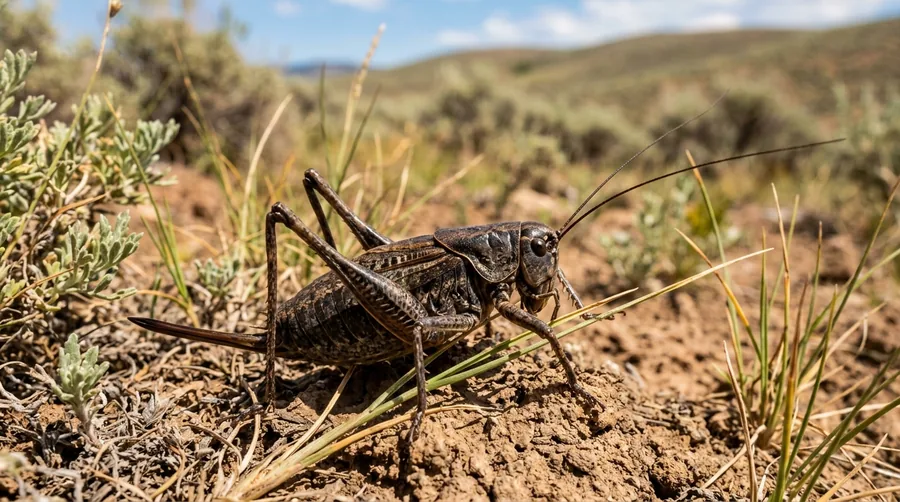
Large brown flightless Mormon cricket katydid walking across dry rangeland soil
Recommended Products


What it does
Mormon crickets are day-active and flightless, so they travel by walking and jumping. In outbreak years, nymphs and adults form dense migrating bands that can march up to a mile a day, stripping vegetation as they go. They are strongly cannibalistic, which helps drive the relentless forward march of a band.
Where it lives
They live in western rangeland dominated by sagebrush and forbs, especially the Great Basin and mountain foothills. Populations build in open sagebrush-grass country, then bands move into adjacent gardens, pastures, and crop fields during outbreaks. They are a western US pest and are not found in the eastern states.
How it breeds
Mormon crickets have one generation per year. Females use a long, sword-like ovipositor to lay eggs in the soil in summer; the eggs overwinter and hatch the following spring. Nymphs pass through about seven stages over roughly two months before becoming adults. Outbreaks can persist in an area for several years.
What it eats
Mormon crickets are omnivorous. They feed on many range plants, forbs, and grasses, and readily attack garden vegetables, small grains, and alfalfa. They also scavenge dead insects and each other, which fuels their cannibalistic marching behavior.
Identification
Adults are large, heavy-bodied katydids up to about 3 inches long, ranging from green and brown to black or reddish. Despite the name they are not true crickets, and their short wings cannot fly. Females carry a long, upward-curving ovipositor that is sometimes mistaken for a stinger.
Signs of an infestation
- Large bands of crickets marching across ground, roads, or fields
- Rapid, heavy defoliation of gardens, grain, or alfalfa
- Chewed stems and stripped leaves on range and crop plants
- Crushed crickets and slick spots on roads where bands cross
- Clusters of insects climbing walls, fences, and vegetation
Prevention tips
- Watch regional outbreak reports and act early in the season
- Use barriers such as metal flashing or plastic sheeting to divert bands
- Till or clear egg-laying sites near gardens where practical
- Protect small plots with row covers or fine-mesh fencing
- Report large bands to your local extension or agriculture office
Professional solutions
Small numbers in a home garden can be hand-collected, fenced out, or trapped. Large outbreaks are a landscape-scale problem beyond DIY control; state and county agencies coordinate rangeland treatments, often using bran bait or targeted insecticides. Contact your local cooperative extension or department of agriculture for current guidance and any area-wide programs.
Health & safety
Mormon crickets do not spread disease and are not venomous. They can deliver a firm pinch with their strong jaws if handled, but they pose no real health threat to people or pets. The damage they cause is agricultural: in outbreak years, bands can destroy gardens, forage, and crops across wide areas.
Relevant Products


Frequently asked questions
Are Mormon crickets actually crickets?
No. Despite the name, the Mormon cricket is a shieldbacked katydid, not a true cricket. It is large and flightless, and the females' long, curved ovipositor is used to lay eggs in soil, not to sting.
Do Mormon crickets bite people?
They are not aggressive and do not seek out people, but a Mormon cricket can give a firm pinch with its strong jaws if you pick one up. They carry no venom or disease, so the main concern is crop and garden damage, not human health.
How do I protect my garden from a Mormon cricket band?
Physical barriers work best: smooth metal flashing, plastic sheeting, or fine-mesh fencing can divert or block a marching band, and row covers protect small plots. For large outbreaks, contact your local extension or agriculture agency about area-wide control.
Fact-checked by Morgan Vance, Editorial Director (editorial review, not a professional pest-control or medical sign-off). Last reviewed August 7, 2026. We correct anything a reader shows us is wrong — see our corrections policy.