
Joro Spider
Trichonephila clavata · also called Joro spider, jorogumo, joro
Quick answer
The Joro spider (Trichonephila clavata) is a large, brightly colored orb-weaver from East Asia now spreading through the southeastern US. Females show yellow and blue-gray bands with red marks and build big golden webs. They are shy, and their venom is harmless to people, causing at most mild, bee-sting-like irritation if they bite.
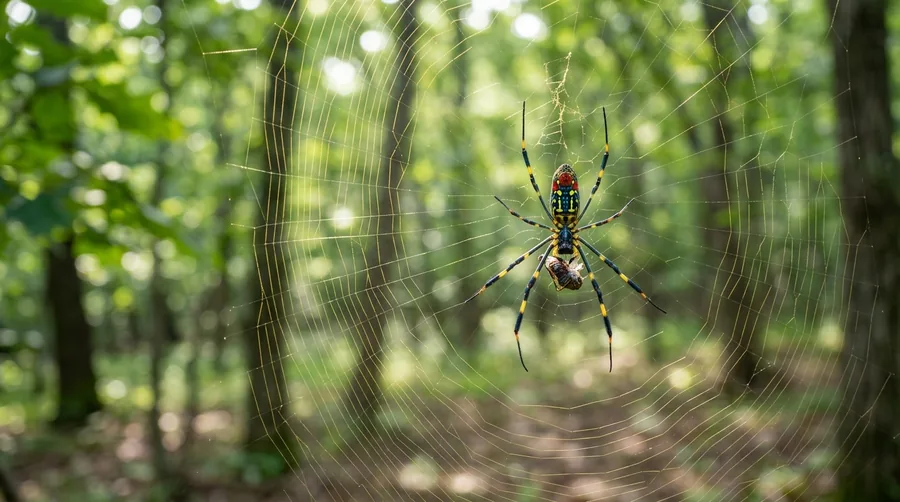
Large yellow, blue-gray, and red Joro spider hanging head-down in a golden orb web
Recommended Products


What it does
Joro spiders are orb-weavers that hang in the center of large, strong, golden-tinted webs, often in clusters. They are timid and slow to bite, usually fleeing or dropping when disturbed. Their webs can span walkways, porches, and garden gaps, which is the main way they bother people. Young spiders balloon on silk to disperse on the wind.
Where it lives
Native to Japan, Korea, and China, the Joro spider arrived in Georgia around 2013 and has spread across the Southeast. It builds webs outdoors in gardens, tree lines, power lines, porches, and between structures, often near homes. It tolerates cold better than many relatives, which may aid its northward spread.
How it breeds
There is one generation a year. In fall, females produce an egg sac holding hundreds of eggs, then die at the first frost. The eggs overwinter, and tiny spiderlings emerge in spring, dispersing by ballooning on silk threads. They grow through the summer, reaching full, showy size by late summer and early fall.
What it eats
Joro spiders eat flying and crawling insects caught in their webs, including mosquitoes, flies, stink bugs, and even the invasive spotted lanternfly. As generalist predators they can be a modest benefit in the garden, helping reduce nuisance and pest insects.
Identification
Females are large and unmistakable: a body around an inch long with bright yellow and blue-gray bands, red markings underneath, and long banded legs spanning three to four inches. Males are much smaller and drab brown. The web is a large, three-dimensional, golden-silk orb, often with tangles of support lines.
Signs of an infestation
- Large golden orb webs across paths, eaves, and gardens
- Big yellow-and-gray spiders sitting head-down in webs
- Clusters of webs in tree lines and along fences
- Small brown males near a female in her web
- Silk egg sacs on bark or structures in fall
Prevention tips
- Clear webs with a broom from doorways and walkways you use
- Trim vegetation and reduce clutter near the house to limit web sites
- Turn off unneeded outdoor lights that draw prey insects
- Relocate spiders outdoors rather than killing beneficial ones
- Knock down and destroy egg sacs in fall to limit next year's numbers
Professional solutions
Joro spiders almost never need professional pest control. They are harmless and even helpful, so the usual advice is to leave them be or relocate them. If webs are truly overwhelming a porch or entry, routine web removal and reduced outdoor lighting solve it. General pest control that lowers their insect prey will indirectly reduce spider numbers.
Health & safety
Joro spiders are not considered dangerous to people or pets. They are shy and rarely bite; their fangs are small and their venom is not medically significant. A bite, which is uncommon, typically causes only brief localized pain and redness, similar to a bee sting. Wash the area and watch for an unusual reaction, but serious effects are not expected.
Relevant Products




Frequently asked questions
Are Joro spiders dangerous to humans?
No. Joro spiders are shy and their venom is not medically significant to people or pets. They rarely bite, and when they do, the result is usually brief pain and redness like a bee sting. They are large and dramatic-looking but essentially harmless.
Are Joro spiders good or bad to have around?
Ecologically they are mostly a nuisance because of their large webs, but they do eat pest insects, including mosquitoes, flies, and even spotted lanternflies. Many people simply relocate them or clear webs from doorways rather than killing what is a harmless, insect-eating spider.
How did Joro spiders get to the US?
The Joro spider is native to East Asia and is thought to have arrived in Georgia around 2013, likely via shipping. Since then it has spread across the Southeast, helped by young spiders ballooning on silk in the wind. It tolerates cold, so its range may keep expanding.
Fact-checked by Morgan Vance, Editorial Director (editorial review, not a professional pest-control or medical sign-off). Last reviewed July 8, 2026. We correct anything a reader shows us is wrong — see our corrections policy.