
Two-Spotted Spider Mite
Tetranychus urticae · also called two-spotted mite, red spider mite, greenhouse spider mite
Quick answer
The two-spotted spider mite (Tetranychus urticae) is a tiny plant-feeding mite and a major pest of crops, gardens, and greenhouses. It pierces leaf cells on the underside of foliage, causing stippling, yellowing, and fine webbing. It does not bite people or damage buildings, but it can quickly ruin plants in hot, dry conditions.
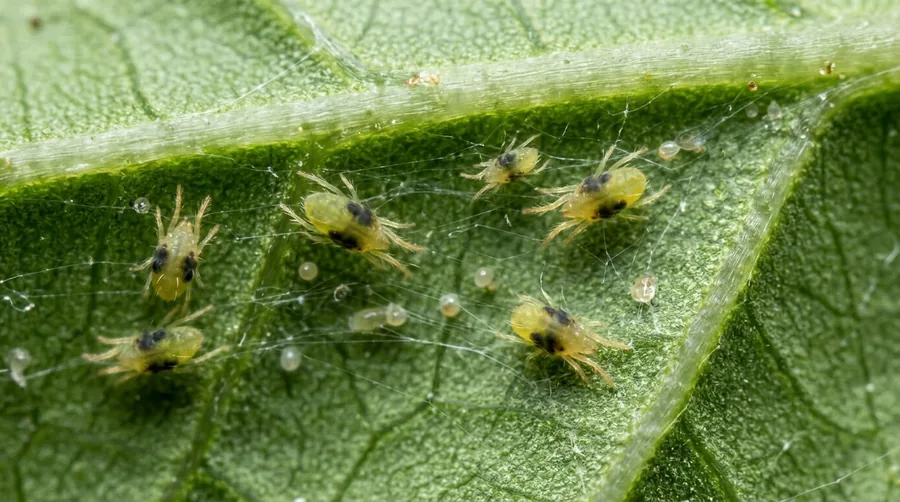
Macro view of pale two-spotted spider mites and fine webbing on the underside of a green leaf
Recommended Products


What it does
Two-spotted spider mites feed on the undersides of leaves, puncturing plant cells and draining their contents. Colonies spin fine silk webbing that shelters them and helps them disperse on wind. They explode in numbers during hot, dry weather, and can defoliate a plant before many gardeners notice them.
Where it lives
This mite attacks hundreds of plant species: vegetables, fruit, ornamentals, houseplants, and field crops. Outdoors it is a warm-season pest across the US; in greenhouses and indoor gardens it is active year-round. It thrives in hot, dusty, drought-stressed conditions and on plants near reflective heat.
How it breeds
Development is extremely fast in heat, completing egg-to-adult in about a week at high temperatures, so generations overlap and populations surge. Females lay many round eggs on leaf undersides. In colder regions, mated females overwinter in bark, debris, and soil, turning orange-red before winter.
What it eats
Two-spotted spider mites feed only on plant tissue, sucking the contents of leaf cells from a wide range of crops, ornamentals, and houseplants. They do not feed on people, animals, food in the pantry, or building materials.
Identification
Adults are about 0.4 mm and need a hand lens; they are pale green-yellow with a dark blotch on each side of the body, turning orange-red in fall. Look for fine webbing and pale stippling on leaves. Tapping foliage over white paper reveals moving specks.
Signs of an infestation
- Fine pale stippling or speckling on leaf surfaces
- Yellowing, bronzing, or drying of leaves
- Delicate silk webbing on leaf undersides and stems
- Tiny moving specks seen when tapping leaves over white paper
- Plant decline and leaf drop during hot, dry weather
Prevention tips
- Inspect leaf undersides regularly, especially in hot, dry spells
- Keep plants well-watered to reduce drought stress
- Rinse or hose down dusty foliage where mites accumulate
- Quarantine and check new plants before adding them
- Encourage beneficial predatory mites and avoid broad-spectrum insecticides
Professional solutions
Two-spotted spider mites are a horticultural pest managed by growers and gardeners, not a structural pest. For crops or greenhouses, an extension agent or agricultural advisor can guide integrated management using predatory mites and EPA-labeled miticides, rotating modes of action because these mites develop resistance quickly.
Health & safety
Two-spotted spider mites pose no direct risk to people or pets; they do not bite, sting, or spread human disease. The harm is economic and horticultural, as heavy infestations weaken and kill plants and can cause significant crop losses in gardens, farms, and greenhouses.
Relevant Products


Frequently asked questions
Do two-spotted spider mites bite humans?
No. Two-spotted spider mites feed only on plants and cannot bite people or pets. If something is biting you, another pest is responsible. This mite's damage is entirely to plants, seen as stippled, yellowing leaves and fine webbing.
How do I get rid of spider mites on my plants?
Rinse leaf undersides with water, remove heavily infested foliage, and reduce drought stress. Predatory mites and horticultural oils or insecticidal soaps help. If using an EPA-labeled miticide, rotate products, because two-spotted mites develop resistance quickly to repeated use of the same chemical.
Why do spider mites appear in hot, dry weather?
Heat speeds their development so a generation can finish in about a week, and drought-stressed, dusty plants are more vulnerable. That combination lets populations explode quickly. Keeping plants watered and foliage rinsed makes conditions less favorable for outbreaks.
Fact-checked by Morgan Vance, Editorial Director (editorial review, not a professional pest-control or medical sign-off). Last reviewed May 9, 2026. We correct anything a reader shows us is wrong — see our corrections policy.