Kissing Bug
Triatoma spp. · also called kissing bugs, conenose bug, bloodsucking conenose
Quick answer
Kissing bugs (Triatoma species) are large, dark, cone-headed insects, often edged with red or orange, that feed on blood at night. Found mainly across the southern US, they can carry the parasite that causes Chagas disease, though locally acquired human cases are rare. They enter homes from animal nests and woodpiles.
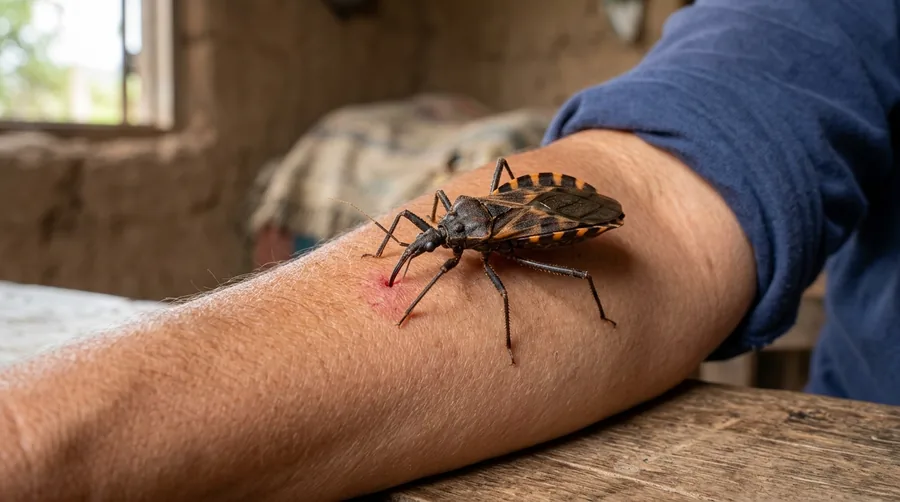
Large dark brown kissing bug with red-orange bands along its abdomen and a cone-shaped head
Recommended Products


What it does
Kissing bugs are nocturnal blood-feeders that hide by day and emerge at night to feed on sleeping hosts, often around the face, which is how they got their name. They are attracted to warmth, carbon dioxide, and porch or window lights, and move indoors from nearby animal shelters.
Where it lives
Outdoors they live in and around the nests and burrows of wood rats, opossums, raccoons, dogs, and other animals, and under porches, in wood and rock piles, and in leaf litter. They are most common across the southern United States and enter homes through gaps, screens, and around lights.
How it breeds
Females lay eggs in sheltered harborage, and the young pass through several nymph stages, each needing a blood meal to develop. The full cycle commonly takes several months to over a year depending on species, temperature, and feeding, so populations build slowly compared with many household insects.
What it eats
Kissing bugs feed only on the blood of mammals, birds, and reptiles, including wildlife, pets such as dogs, and sometimes people.
Identification
Adults are large, 14-28 mm, with an elongated oval body, a narrow cone-shaped head, and long legs. Most US species are dark brown to black, and many have red-orange bands around the flattened edge of the abdomen. They are sometimes confused with harmless leaf-footed or wheel bugs.
Signs of an infestation
- Bites, often on the face, appearing overnight
- Dark blackish fecal specks near sleeping areas or wall cracks
- Large cone-headed bugs seen indoors at night near lights
- Bugs found around pet resting areas or in animal nests outdoors
Prevention tips
- Seal cracks, gaps, and torn screens around doors, windows, and the foundation
- Turn off or reposition outdoor lights that draw them at night
- Move woodpiles, rock piles, and animal nests away from the house
- Keep pets from sleeping outdoors against the home where bugs gather
- Use tight-fitting screens on windows, vents, and chimneys
Professional solutions
Because kissing bugs can carry a disease-causing parasite, correct identification matters; keep any suspected bug for identification rather than crushing it against skin. Control focuses on sealing the home and reducing outdoor harborage. A pest professional can inspect entry points and treat perimeter and animal-nest areas; contact a doctor if you have concerns about a bite.
Health & safety
Kissing bugs can carry Trypanosoma cruzi, the parasite that causes Chagas disease, which spreads when infected bug feces enter a bite wound, the eyes, or the mouth, not through the bite itself. In the US, locally acquired human infections are rare, but the risk is real, so treat these bugs cautiously and avoid handling them bare-handed.
Relevant Products




Frequently asked questions
Are kissing bugs dangerous?
Kissing bugs can carry the parasite that causes Chagas disease, so they are worth taking seriously. However, transmission requires infected bug feces entering a bite, the eyes, or the mouth, and locally acquired human cases in the US are rare. Avoid crushing them on your skin and keep any specimen for identification.
How do kissing bugs get into the house?
They typically move in from nearby animal nests, woodpiles, and burrows, entering through gaps around doors and windows, torn screens, and cracks in the foundation. Outdoor lights at night also draw them toward homes. Sealing entry points and reducing outdoor harborage are the best defenses.
What should I do if I find a kissing bug?
Do not crush it against your skin. If possible, capture it in a container without touching it directly, and contact your local extension office or a pest professional for identification. If you are bitten and have health concerns, especially where Chagas occurs, talk to a doctor. Poison Control (1-800-222-1222) can advise on exposure questions.
Fact-checked by Morgan Vance, Editorial Director (editorial review, not a professional pest-control or medical sign-off). Last reviewed June 15, 2026. We correct anything a reader shows us is wrong — see our corrections policy.